ODP CERTIFICATE CARD ONTARIO: REQUIREMENTS & RENEWAL 2026
How the Ontario ODP card fits beside your G3, G2, or G1 path — what it covers, who needs it on site, how to get it, and how to keep it current without losing field hours.
# ODP certificate card Ontario Guide 2026: Requirements & Renewal
You're studying for your G3 or already working toward G2, and somebody on site asks a simple question that catches a lot of apprentices off guard: "Do you have your ODP card?"
If your whole focus has been TSSA exams, gas code, venting, piping, purging, and CSA B149.1, that question can feel sideways. But in Ontario HVAC work, it matters. A lot of gas fitters touch equipment that sits right beside refrigerant circuits, and some jobs stall fast when the person sent to do the work can't legally handle refrigerant or even pick it up from a supplier.
That's where the Ontario ODP card comes in. It's separate from your G3, G2, or G1 path. It doesn't replace your gas licence, and your gas licence doesn't replace it. If you're building a career that includes furnaces, RTUs, split systems, heat pumps, or any mixed heating and cooling work, you need to know exactly where this credential fits so you don't waste time, miss work, or assume your TSSA ticket covers something it doesn't.
WHY YOUR ODP CARD MATTERS AS A GAS FITTER
A lot of Ontario apprentices hear about the ODP card for the first time in the middle of a normal workday. You're booked with a licensed tech on a furnace and A/C call. The heating side makes sense. You've been drilling gas controls, venting clearances, combustion air, and code rules under **CSA B149.1** because that's what moves you toward your TSSA licence.
Then the cooling side comes up, and suddenly your gas ticket isn't the whole story.
For Ontario gas fitters, that's the key point. Your **G3, G2, or G1** is about fuel work and safety under the TSSA framework. The ODP card sits in a different lane. It matters because a lot of real field work isn't neatly separated into "gas only" and "cooling only." Residential service calls often involve a furnace paired with a condensing unit. Commercial work often means packaged rooftop equipment where gas heat and cooling live in the same cabinet.
> **Practical rule:** If the job can put you in contact with refrigerant handling, don't assume your gas path covers it.
That's why the ODP card Ontario workers talk about is less of a bonus credential and more of a basic gatekeeper for mixed HVAC work. Without it, you can still be a gas fitter in the right scope, but you may be limited on jobs your employer can send you to. That affects call coverage, install crews, seasonal work, and how useful you are to a shop that handles both heat and cooling.
THE SEPARATION THAT MATTERS ON SITE
Gas fitters who understand this early avoid a common mistake. They don't bundle every credential into one mental box.
- **Your TSSA gas licence** governs your gas work, appliance scope, and code responsibilities tied to fuel systems.
- **Your ODP card** deals with legal refrigerant handling.
- **Your refrigeration trade qualification**, if applicable, is its own issue again.
That distinction matters when you're talking to employers, suppliers, or journeypersons. If somebody asks whether you've got your ODP, they aren't asking whether you know gas code. They're asking whether you can legally handle the refrigerant side of the work that often shows up right beside it.
WHY EMPLOYERS CARE
From a shop owner's side, a tech who has both the right gas scope and the ODP card is easier to dispatch. They don't need to reshuffle the board because the assigned person can do the heat side but not the refrigerant handling part.
That's the practical reason this card matters so much on the G3 to G2 to G1 track. It doesn't replace your main licence path. It removes a roadblock that can otherwise follow you from apprentice level into full field work.
UNDERSTANDING THE ONTARIO ODP FRAMEWORK
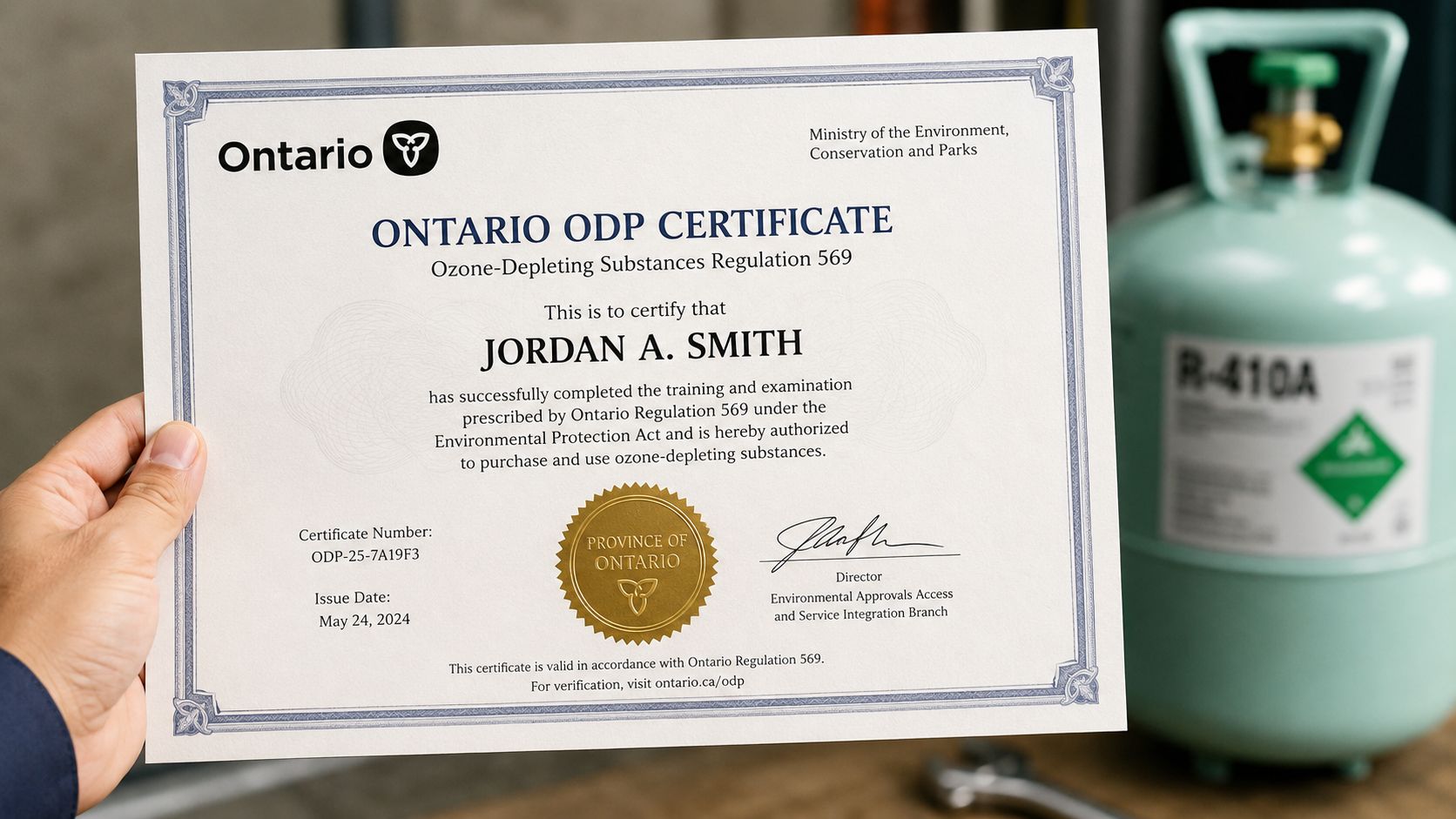
A lot of apprentices hear "ODP license" and file it in the same mental drawer as G3, G2, or G1. That is where the confusion starts.
In Ontario, the ODP card sits beside the gas-fitter path, not inside it. It covers refrigerant handling under environmental rules. Your TSSA gas licence covers gas work, appliance scope, venting, combustion, and code responsibilities. If you mix those up, you can end up legal on the heat side and offside on the cooling side of the same job.
WHAT THE CARD DOES AND DOES NOT DO
The ODP card gives you legal authority for refrigerant-related tasks that Ontario controls, mainly purchasing and handling refrigerants. It does not make you a licensed refrigeration mechanic. It does not expand your gas scope. It does not turn a G2 or G1 into someone who can perform any refrigeration repair just because the equipment also has a gas section.
That distinction matters more on real jobs than in class. A rooftop unit, split system, or package unit can involve gas heat and refrigerant in the same cabinet. Gas fitters on the G3 to G2 to G1 track run into that overlap all the time. The ODP card covers one part of that overlap. It does not replace the rest of the trade qualifications that may still apply.
Here is the practical test I give apprentices. If the task involves the fuel side, ask what your TSSA gas scope allows. If the task involves refrigerant purchase or handling, ask whether you hold the ODP card. If the task is actual refrigeration service beyond that, check whether a separate refrigeration qualification is also required.
WHERE IT SITS BESIDE YOUR TSSA PATH
This is the part many competitors gloss over. For Ontario gas fitters, ODP is a separate environmental credential that supports field usefulness on mixed HVAC work, but it is not part of the TSSA ladder itself.
Your main progression is still G3 to G2 to G1. That is the track that governs gas appliances and fuel work. The ODP card fills a different compliance need that shows up beside that track, especially in residential and light commercial HVAC where heating and cooling are tied together in the same call.
Ontario keeps the ODP process fairly contained. You take an approved course, write the exam, and keep the card current. It is manageable, but shops still get burned when techs treat it like a throwaway certificate and let it lapse.
That leads to three straightforward takeaways:
1. **ODP is a separate credential.** Do not list it as if it were your gas licence.
2. **It solves a specific legal issue.** It covers refrigerant handling, not broad refrigeration scope.
3. **It needs to stay current.** Expired paperwork can take you off part of a job even if your gas licence is in good standing.
Clear wording helps on site and in interviews. "I have my G2 and a current ODP card" tells an employer you understand how Ontario separates gas licensing from refrigerant compliance. That sounds like someone who knows the rules before the dispatcher has to explain them.
WHO NEEDS AN ODP CARD ON THE JOB
The easiest way to understand who needs an ODP card is to stop thinking in job titles and think in tasks.
A shop might hire you as an HVAC helper, gas fitter apprentice, G2 technician, or service tech. None of those labels answers the compliance question by itself. The key question is whether the work puts you in the stream of purchasing or handling refrigerant.
COMMON JOBSITE SITUATIONS
A **G3 apprentice** may not be leading an A/C service call, but that doesn't mean the ODP card is irrelevant. If that apprentice is sent with a senior tech on a split-system install and gets asked to deal with the refrigerant side, the card suddenly matters. The same goes if the apprentice is told to swing by a supplier and pick up refrigerant for the day's jobs.
A **G2 technician** runs into this even more often. Residential Ontario work rarely stays in one lane. A furnace replacement can be tied to cooling considerations. A service call may start as "no heat" and end with discussion about the matched A/C system, refrigerant concerns, or a cooling complaint the homeowner adds once you're already there.
A **G1 technician** sees the same issue on larger equipment. Commercial rooftops, makeup air units with cooling sections, and other integrated systems often mean gas heat and refrigerant-related work live in the same piece of equipment. On paper the scopes are separate. On site they're neighbours.
> The card matters most on the jobs where the heating and cooling sides meet. That's a big part of Ontario HVAC work.
WHERE APPRENTICES GET TRIPPED UP
The usual mistakes are practical, not theoretical.
- **They think "I'm only helping."** If the task involves handling refrigerant, being a helper doesn't change the requirement.
- **They think the company card covers them.** Employer capability and individual credentialing aren't the same thing.
- **They assume supply counters won't ask.** Suppliers often want to see the proper card before selling refrigerant.
- **They mix up trade authority with environmental compliance.** Being trusted by a journeyperson isn't the same as being authorised under the rule.
A lot of apprentices also underestimate how this affects dispatch. When a busy summer board gets built, managers tend to send the person who can complete the whole call without a credential problem popping up halfway through. If you can work the gas side but can't cover refrigerant handling where needed, somebody else gets the more complete call.
A SIMPLE WAY TO DECIDE
Ask yourself three questions before assuming you're fine:
1. **Will I need to buy refrigerant?**
2. **Will I need to handle refrigerant?**
3. **Does this equipment combine gas heat with cooling components that create that possibility?**
If the answer trends toward yes, the ODP card belongs on your list. For Ontario gas fitters on the G-track, it's one of those supporting credentials that effectively makes you more usable in the field.
HOW TO GET YOUR ONTARIO ODP CARD
A lot of G3s and new G2s leave this too late. Then a shop wants them on a rooftop unit, a combo system, or a service call that touches refrigerant, and the missing ODP card becomes the reason they stay in the truck or get passed over for the call.
The process itself is simple. The mistake is treating it like paperwork you can sort out later.
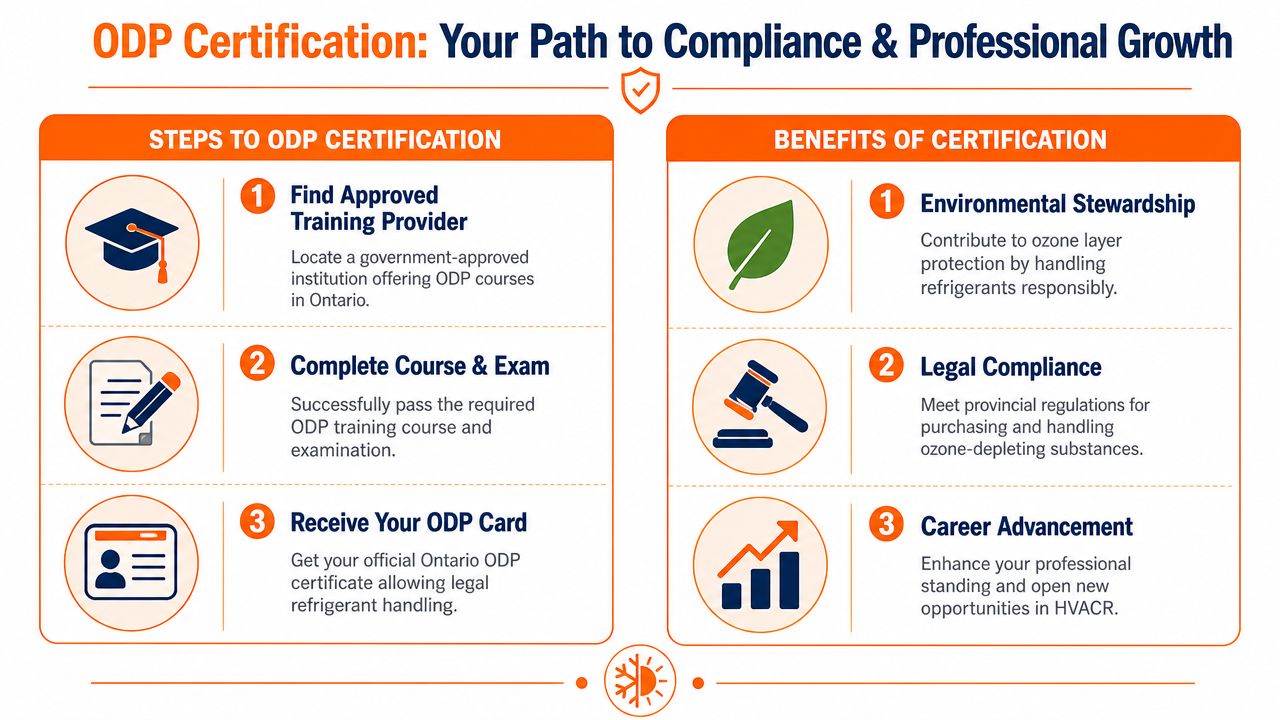
PICK THE PROVIDER THAT FITS YOUR WORK WEEK
Brand recognition is not the main issue here. Delivery format, scheduling, and how quickly you can finish matter more, especially if you are already balancing install days, service work, or your next step on the gas side.
Ontario learners have a few common options. The [HRAI ODP/ODS online program page](https://www.hrai.ca/odp-ods-online-program) lists an online option at **$275 + HST** with **30 days** to complete it. Centennial lists a virtual instructor-led course at **$285**. HiMark lists an **8-hour** in-person course at **$310.75**.
Those are small price differences. Lost work time is usually the bigger cost.
#### Ontario ODP Training Provider Comparison (2026)
| Provider | Format | Approx. Cost (CAD) | Notes |
| --- | --- | --- | --- |
| HRAI | Online | $275 + HST prices may vary | Self-paced option with 30 days to finish |
| Centennial College | Virtual instructor-led | $285 prices may vary | Better fit if you want a scheduled live class |
| HiMark | In-person | $310.75 prices may vary | Good for people who learn better in a classroom |
Use the format that gives you the best chance of finishing cleanly on the first try.
- **If your schedule changes every week**, HRAI's self-paced format is often easier to finish without missing a workday.
- **If you do better with a live instructor**, Centennial's virtual class gives you more structure.
- **If you retain more in a classroom**, HiMark may be worth the extra cost and the fixed time commitment.
NATS also offers Ontario ODP training and shorter recertification formats. That matters more later, but it is worth noticing now if you are choosing a provider you may want to use again.
WHAT THE PROCESS ACTUALLY LOOKS LIKE
Most gas fitter apprentices expect red tape. In practice, it is a short sequence.
1. **Choose an approved provider.** Book before peak cooling season if you can. Waiting until the job requires the card usually means fewer convenient dates.
2. **Confirm the course format and timing.** A self-paced course sounds flexible until it sits unfinished for three weeks. A live course sounds efficient until it conflicts with overtime or site travel.
3. **Complete the course and write the exam.** Treat it seriously. ODP is separate from your G3, G2, or G1 path, but it still has to be passed and documented properly.
4. **Store your proof where you can get it quickly.** Keep a digital copy and a backup. Office staff, employers, and suppliers may ask for it at inconvenient times.
The cheapest seat is not always the lowest-cost choice. If one format causes a missed shift, a rebooking fee, or weeks of delay, the small savings disappear.
For Ontario gas fitters, the main thing to keep straight is that ODP does not replace any part of your TSSA gas licensing path. It sits beside it. If you are planning your training in the right order, this guide on [how to become a gas fitter in Ontario](https://flamepath.co/how-to-become-a-gas-fitter-ontario) helps put the ODP card in the right place relative to your G3, G2, and G1 progression.
MANAGING YOUR ODP RENEWAL AND COMPLIANCE
A gas fitter usually gets tripped up on ODP during a busy stretch, not at the start. The card sits in a wallet, the truck stays full, and then a service call, hiring package, or site check turns up an expired credential.
For Ontario techs on the G3 to G2 to G1 path, that mistake is easy to make because ODP is not the licence you build your trade around. It is a separate environmental credential that sits beside your TSSA track. That separation is exactly why it gets overlooked.
As noted earlier, the card does not last forever, and letting it expire can send you back into the training process instead of a simple administrative update. If you already hold equivalent certification from another Canadian province or territory, Ontario has an application path that may save you from retaking the course. Check that before you spend money you did not need to spend.
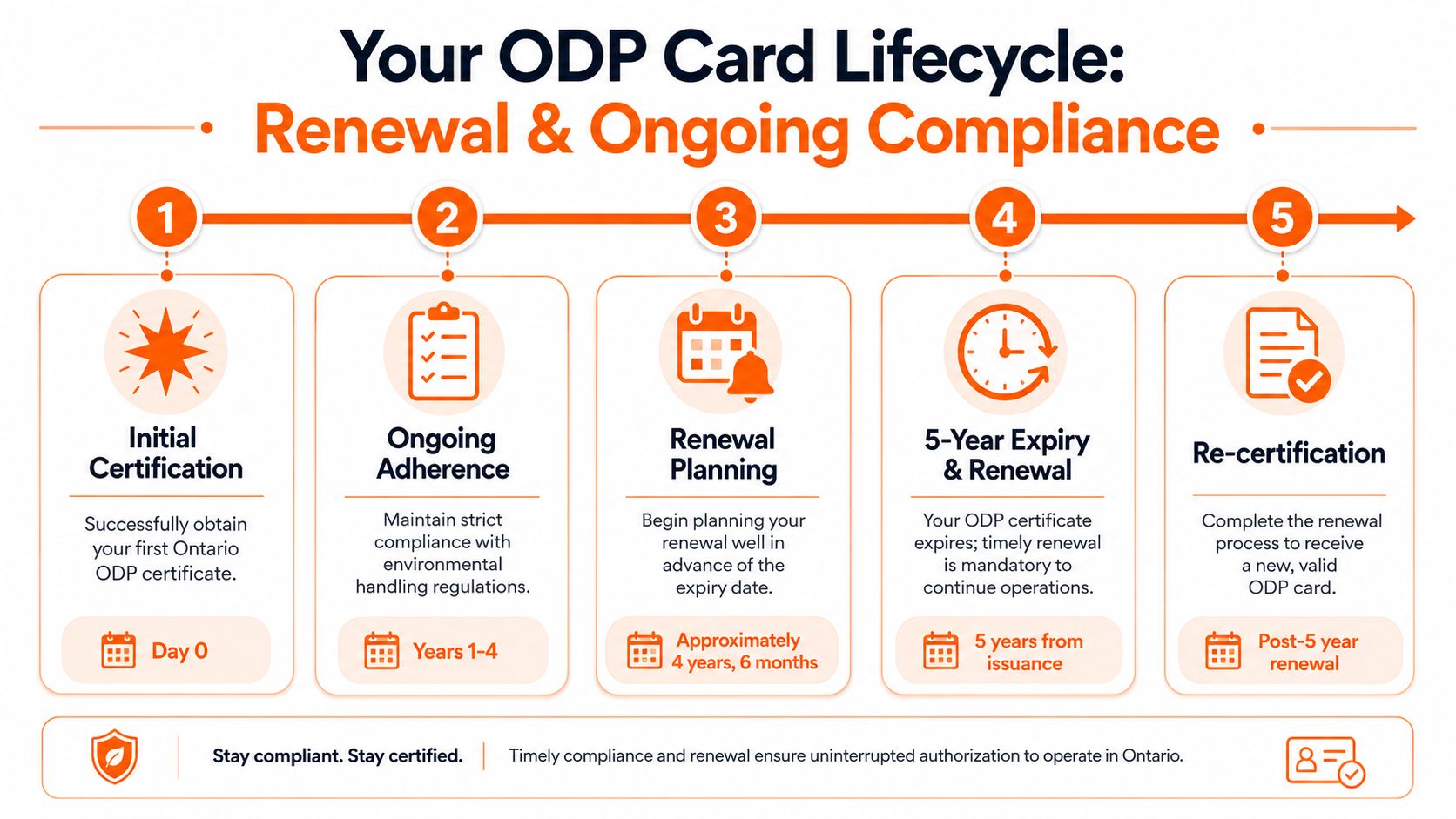
WHY WAITING UNTIL EXPIRY COSTS MORE THAN THE COURSE
The true cost is rarely the class fee. It is lost flexibility.
Once the card has lapsed, the problem spills into scheduling, dispatch, and onboarding. A shop may hold you off certain calls. A new employer may stall your start date until your paperwork is current. If course dates are limited, one missed window can drag the problem out longer than expected.
I have seen apprentices assume ODP can wait because their gas licence work is the priority. The gas path is the priority. But if your role touches equipment where refrigerant handling can come up, an expired ODP card still creates a very practical bottleneck. It does not matter that your G2 or G1 study plan is on track if the side credential needed for the job is dead.
The simple rule is to manage ODP by lead time, not by expiry month.
PRACTICAL HABITS THAT KEEP THE CARD FROM BECOMING A PROBLEM
Good compliance is mostly record-keeping and timing.
- **Save the issue and expiry dates right away.** Put them in your phone, your work email calendar, and whatever folder you use for trade documents.
- **Set reminders early enough to act.** Give yourself enough time to compare course dates, confirm availability, and avoid booking in a panic.
- **Keep proof in more than one place.** Store a clean digital copy on your phone and a backup in cloud storage or email.
- **Separate ODP from your gas licences in your records.** Your G3, G2, or G1 documents prove gas scope. Your ODP card covers refrigerant handling. Mixing them up causes delays with employers and office staff.
- **Check transfer options before booking a course.** If you are coming from another province, confirm whether your current certification can be recognized in Ontario first.
For gas fitters, compliance also means knowing where the ODP requirement ends and where your gas-code duties begin. If that line still gets blurry on jobs involving fuel-fired equipment tied to cooling systems, this guide to [CSA B149.1 requirements in Ontario](https://flamepath.co/csa-b149-1-explained) is worth reviewing.
YOUR NEXT STEP ACING THE TSSA GAS LICENCE EXAM
The ODP card matters, but it should stay in its proper place in your career plan. It's a supporting credential. Your main trade momentum still comes from your **G3, G2, or G1** licence path, because that's what defines your gas scope and the work you can legally perform under Ontario's gas framework.
That's why a lot of apprentices get better results when they organise their study priorities properly. Handle the side credential cleanly. Don't let it distract from the exam path that drives your earnings, your scope, and your long-term progression.
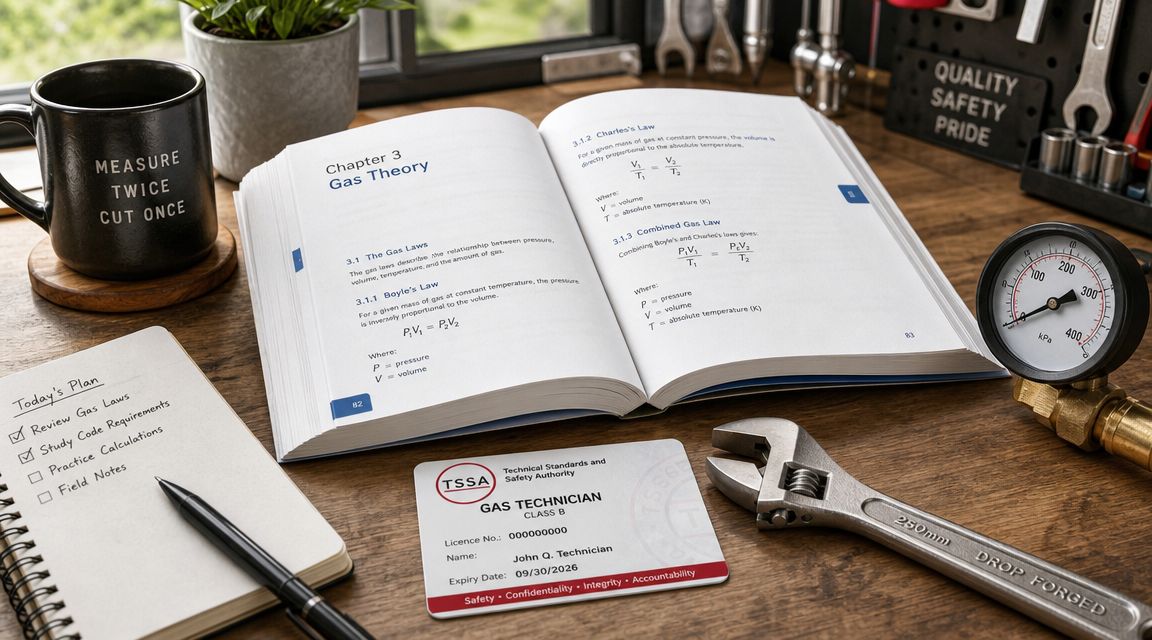
KEEP THE CREDENTIALS IN THE RIGHT ORDER
A smart Ontario tech sees the difference between "needed on many jobs" and "core licence." The ODP card helps you stay useful on HVAC calls involving refrigerant handling. Your gas exam path is what opens the door to legal gas work and bigger responsibility.
That distinction matters most when you're busy. If your study time is limited after work, focus it where the return is highest. Gas code, appliance operation, venting, piping, regulators, combustion, and Ontario exam readiness should sit at the centre of your plan.
USE FOCUSED PREP FOR THE LICENCE THAT DRIVES YOUR SCOPE
General HVAC studying usually isn't enough for TSSA exams. Ontario gas candidates need Ontario-specific prep, tied to the exam style and tied to the code book they're tested on.
That's why targeted practice matters more than random reading. You need repetition, mock-style questions, and clear explanations of why an answer is wrong, especially when you're working through CSA B149.1 and Ontario Regulation 212/01 concepts under time pressure.
If you're building toward G3 first, this [Ontario G3 gas fitter exam prep resource](https://flamepath.co/g3-gas-fitter-exam-prep-ontario) is a practical place to start.