ONTARIO GAS TECHS: YOUR CAN/CSA B149.1 GUIDE 2026
A practical guide to CAN/CSA B149.1 for Ontario gas fitter candidates preparing for G3, G2, and G1 TSSA exams. Learn how the code, O.Reg. 212/01, and TSSA fit together.
# Ontario Gas Techs: Your Can Csa B149.1 Guide 2026
Most Ontario gas fitter candidates hit the same wall. You open the CAN/CSA B149.1 book, flip a few pages, and it feels like you've been handed a brick of clauses, tables, definitions, and cross-references with no map.
That reaction is normal.
I've seen apprentices freeze up the first time they try to study from it. They expect a teaching manual. What they get is a technical code book. It doesn't read like a college module, and it doesn't hold your hand. On the job, that's not a problem because you learn with guidance. In exam prep, it becomes a problem fast if you don't know the book's true purpose.
The good news is that **CAN/CSA B149.1 is not something you need to “read like a novel.”** You need to learn how to use it. That's a completely different skill. Once candidates realise that, the code stops looking like an obstacle and starts acting like the most important tool they own.
For Ontario gas techs, this isn't optional. Your G3, G2, and G1 exams sit on top of the rules that govern gas installation work in the province. If you don't understand where B149.1 fits, how Ontario applies it, and how TSSA expects you to work with it, you're studying in the dark.
> The candidates who usually struggle aren't always the ones who know the least. They're often the ones who never learned how the code, the regulation, and enforcement fit together.
If you're searching for a practical guide to **CAN CSA B149.1**, that's the main issue to solve. Not just “what does the code say,” but “what does it mean for an Ontario exam and an Ontario job site.”
<a id="introduction-decoding-your-most-important-tool"></a>
TABLE OF CONTENTS
- [Introduction Decoding Your Most Important Tool](#introduction-decoding-your-most-important-tool)
- [Why the code feels harder than it is](#why-the-code-feels-harder-than-it-is)
- [What strong candidates do differently](#what-strong-candidates-do-differently)
- [What Is the CAN CSA B149.1 Gas Code](#what-is-the-can-csa-b1491-gas-code)
- [A national code with a wide job-site reach](#a-national-code-with-a-wide-job-site-reach)
- [Why Ontario candidates need the code itself](#why-ontario-candidates-need-the-code-itself)
- [B149.1 vs Ontario Regulation 212 01 and TSSA](#b1491-vs-ontario-regulation-212-01-and-tssa)
- [The relationship between the code, the regulation, and TSSA](#the-relationship-between-the-code-the-regulation-and-tssa)
- [B149.1 vs O.Reg 212 01 vs TSSA Roles Explained](#b1491-vs-oreg-212-01-vs-tssa-roles-explained)
- [How this shows up on the exam and in the field](#how-this-shows-up-on-the-exam-and-in-the-field)
- [Key B149.1 Clauses for Your G3 G2 and G1 Exams](#key-b1491-clauses-for-your-g3-g2-and-g1-exams)
- [What G3 candidates should lock down first](#what-g3-candidates-should-lock-down-first)
- [Where G2 candidates start losing marks](#where-g2-candidates-start-losing-marks)
- [What pushes G1 prep into a different category](#what-pushes-g1-prep-into-a-different-category)
- [How to prioritise your study time](#how-to-prioritise-your-study-time)
- [How to Use the B149.1 Code Book to Study Effectively](#how-to-use-the-b1491-code-book-to-study-effectively)
- [Navigation beats memorisation](#navigation-beats-memorisation)
- [A practical way to train with the book](#a-practical-way-to-train-with-the-book)
- [What does not work](#what-does-not-work)
- [Accessing the Code and Final Exam Prep Tips](#accessing-the-code-and-final-exam-prep-tips)
- [Get the right edition first](#get-the-right-edition-first)
- [Final exam prep that holds up under pressure](#final-exam-prep-that-holds-up-under-pressure)
- [Your Final Step to TSSA Exam Confidence](#your-final-step-to-tssa-exam-confidence)
INTRODUCTION DECODING YOUR MOST IMPORTANT TOOL
A lot of apprentices treat the code book like a hurdle between them and the licence. That's backwards. The book is the trade in printed form. If you install gas equipment in Ontario, sooner or later you come back to the code.
That's true in class, in a basement mechanical room, during a rough-in, and when an inspector asks why something was done a certain way. It's also true when an exam question gives you just enough detail to tempt you into guessing. Guessing is what sinks people.
<a id="why-the-code-feels-harder-than-it-is"></a>
WHY THE CODE FEELS HARDER THAN IT IS
The code feels dense because it was written to set minimum installation requirements, not to teach from scratch. It assumes you're willing to look things up, follow definitions carefully, and pay attention to conditions. Most mistakes happen when candidates skim a clause and miss the limitation attached to it.
A common example is when someone remembers the broad idea of a rule but not the exact boundary. On the floor, that leads to bad decisions. On an exam, it leads to choosing an answer that sounds familiar but doesn't match the code language.
- **If you read casually**, the code feels disconnected.
- **If you read by topic**, it starts to make sense.
- **If you practise finding answers under time pressure**, it becomes usable.
<a id="what-strong-candidates-do-differently"></a>
WHAT STRONG CANDIDATES DO DIFFERENTLY
The strongest candidates don't try to become human photocopiers. They build a working relationship with the book. They know where pressure, venting, piping, clearance, appliance, and definitions material live. They've trained themselves to move through the index and clause structure without panicking.
> **Practical rule:** Treat the code book like a service manual. You don't admire it. You use it.
That's the mindset that changes everything. Once you stop trying to memorise every line and start learning the hierarchy behind the rules, your prep gets sharper and your job-site judgement gets better.
<a id="what-is-the-can-csa-b1491-gas-code"></a>
WHAT IS THE CAN CSA B149.1 GAS CODE
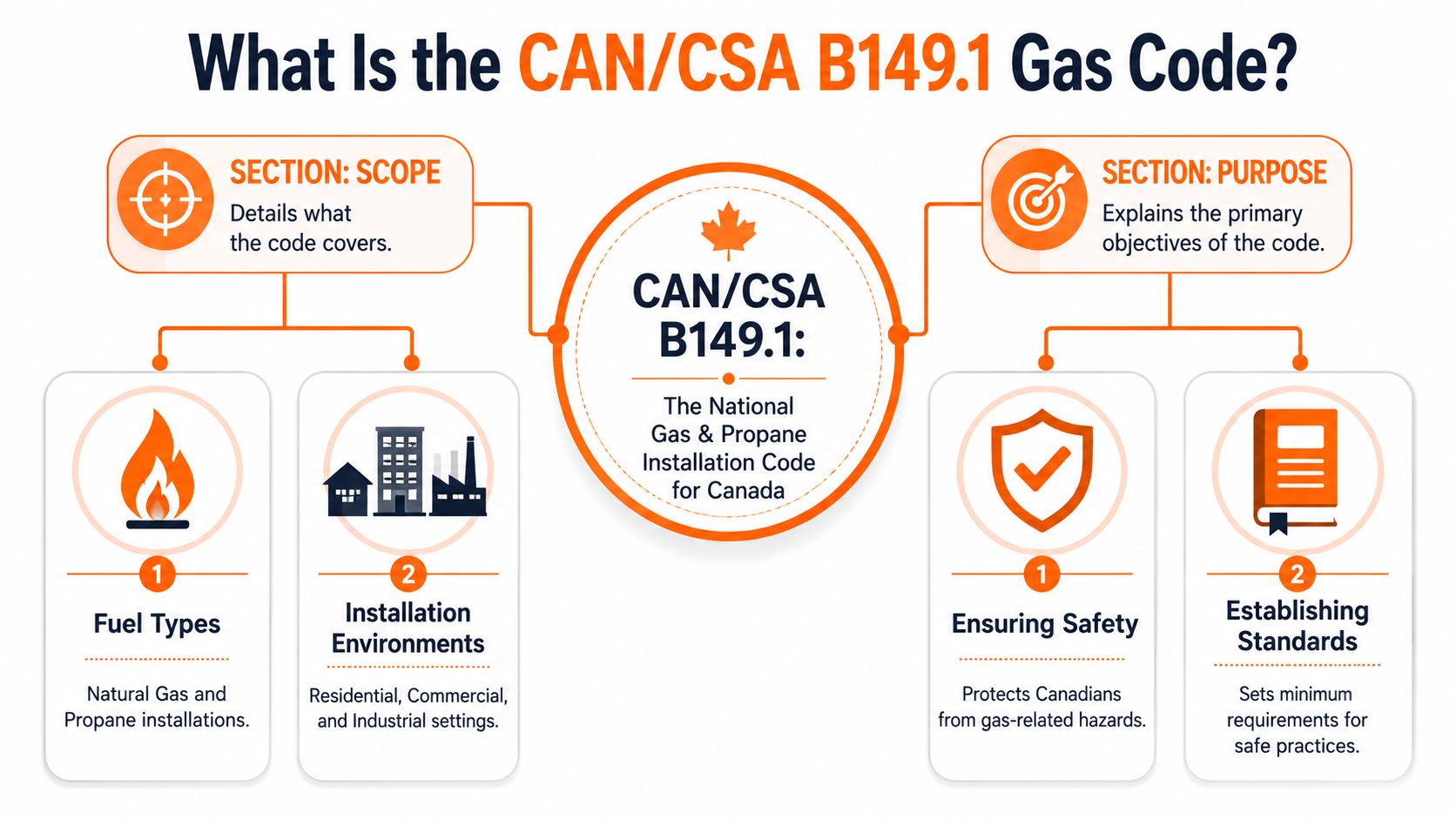
**CAN/CSA B149.1** is the Canadian installation code for gas-fired systems. It's a national technical standard for the installation of appliances, equipment, components, and accessories where gas is used as fuel, plus piping and tubing from the utility termination or propane tank, as set out in the [Standards Council of Canada listing for CSA B149.1](https://scc-ccn.ca/standardsdb/standards/4020168).
<a id="a-national-code-with-a-wide-job-site-reach"></a>
A NATIONAL CODE WITH A WIDE JOB-SITE REACH
Many new techs often underestimate it. They think B149.1 is mostly about hooking up appliances. It isn't. The scope reaches from the fuel supply side into the installation itself, so the code touches piping layout, accessories, appliance connection, and application limits.
That's why a serious Ontario student can't rely on generic summaries. You need the actual code language. If you want a broader orientation before you get deep into clauses, this breakdown of [Ontario gas code rules for G3, G2, and G1 exams](https://flamepath.co/blog/ontario-gas-code-explained-for-g3-g2-g1-exams) is useful as a companion, but your real anchor is still the code book.
<a id="why-ontario-candidates-need-the-code-itself"></a>
WHY ONTARIO CANDIDATES NEED THE CODE ITSELF
B149.1 has been around a long time. It was first published in **1958**, and industry coverage describes it as a foundational Canadian installation code for appliances, equipment, and piping from the utility termination or propane tank, which is why it sits underneath Ontario G3, G2, and G1 exam content, as noted in this [CSA B149 code series overview](https://aspe.org/pipeline/csa-group-releases-updated-b149-code-series-for-the-natural-gas-and-propane-industries/).
That history matters for one reason. It tells you this isn't a temporary guideline or a training handout. It's the rulebook the trade has worked from for decades, and it keeps evolving with the industry.
For exam prep, the practical takeaway is simple:
- **Know the scope:** the code covers more than appliance hookup.
- **Use the complete book:** summaries help, but they won't save you on detailed questions.
- **Study by application:** fuel delivery, piping, venting, controls, and appliances belong together.
If you're trying to understand **CAN CSA B149.1** in a way that helps in Ontario, think of it as the technical backbone behind the work you'll be licensed to do.
<a id="b1491-vs-ontario-regulation-212-01-and-tssa"></a>
B149.1 VS ONTARIO REGULATION 212 01 AND TSSA
A candidate passes a practice question on venting, then misses the next one because they do not know whether the examiner is asking about a code rule, a legal requirement, or TSSA's role in enforcing both. That confusion shows up on exams and on job sites all the time in Ontario.
<a id="the-relationship-between-the-code-the-regulation-and-tssa"></a>
THE RELATIONSHIP BETWEEN THE CODE, THE REGULATION, AND TSSA
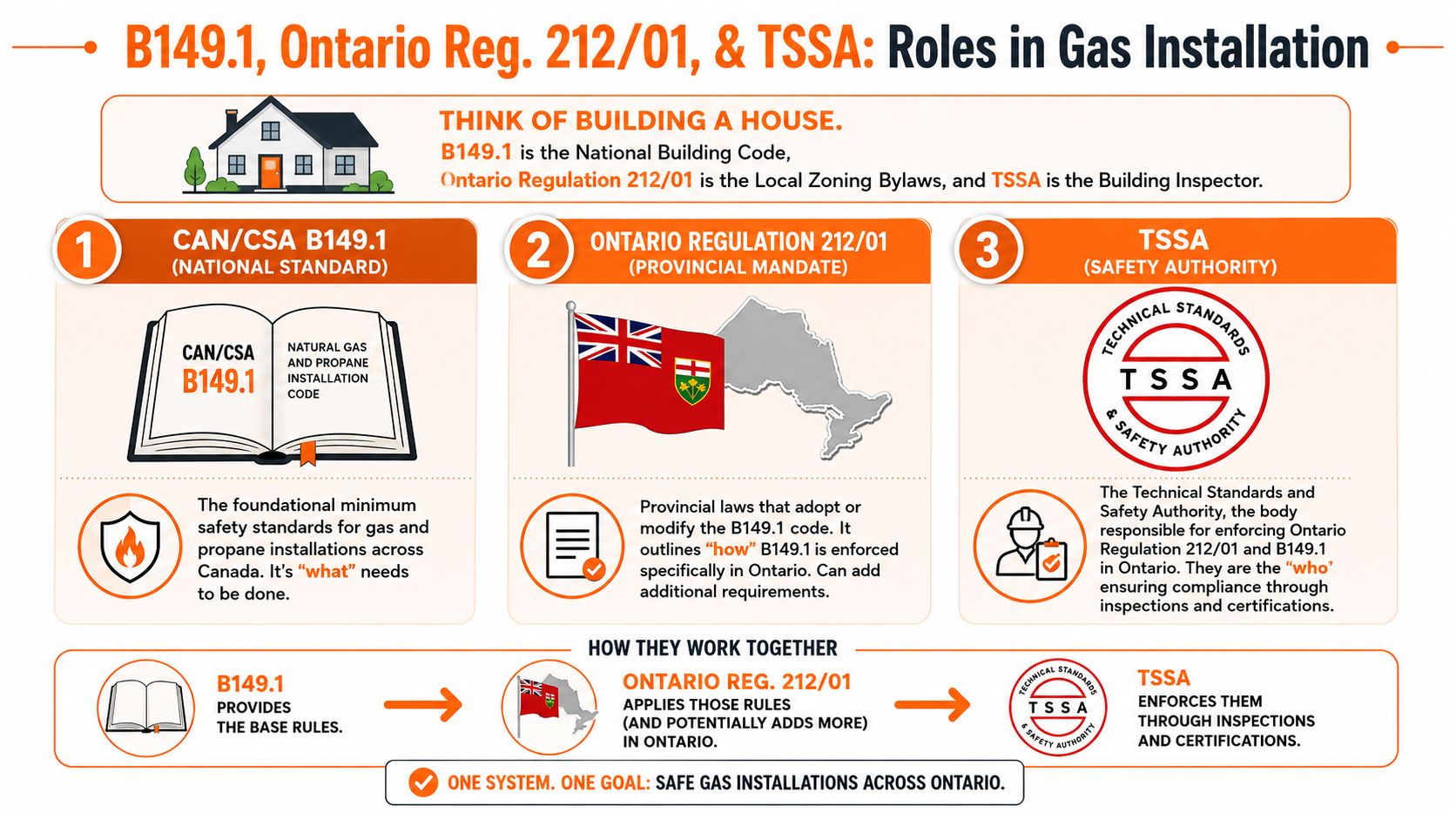
**B149.1** sets the technical rules for installing gas piping, appliances, venting, air supply, clearances, controls, and related equipment. It tells you what an acceptable installation looks like.
**Ontario Regulation 212/01** gives legal force to gas work requirements in Ontario. It sits under the Technical Standards and Safety Act and governs who may do the work, what approvals apply, and how compliance is handled in the province.
**TSSA** administers and enforces that framework. In practical terms, that means registration, certification, examinations, inspections, incident oversight, and orders where work does not meet the law or adopted code requirements.
For exam purposes, stop lumping them together as “the rules.” They are connected, but they are not interchangeable.
> B149.1 gives the technical answer. O.Reg 212/01 makes gas work a legal compliance issue in Ontario. TSSA is the authority that tests, inspects, and enforces that standard in real life.
<a id="b1491-vs-oreg-212-01-vs-tssa-roles-explained"></a>
B149.1 VS O.REG 212 01 VS TSSA ROLES EXPLAINED
| Entity | Primary Role | What It Means For You |
|---|---|---|
| **CAN/CSA B149.1** | Technical installation standard | You use it to decide whether the installation method, material, location, or venting arrangement meets code |
| **Ontario Regulation 212/01** | Provincial legal framework for gaseous fuels work | You need to know that gas work is controlled by law in Ontario, including licensing, permissions, and compliance duties |
| **TSSA** | Enforcement, inspection, and certification authority | Your exam path, field inspections, and consequences for non-compliant work all sit here |
<a id="how-this-shows-up-on-the-exam-and-in-the-field"></a>
HOW THIS SHOWS UP ON THE EXAM AND IN THE FIELD
Ontario exam questions often test the relationship, not just the clause. A question may ask what is permitted by code, but the critical check is whether you understand that the answer has legal weight once the work falls under Ontario's regulated gas framework.
That distinction matters even more on site. Apprentices hear shop habits, rules of thumb, and old installer shortcuts. Some are harmless. Some will get rejected on inspection. I tell students the same thing I tell new fitters in the field: if a senior person says, “we always do it this way,” open the book and confirm it. The code decides the technical requirement. Ontario law decides whether the work is authorized and enforceable. TSSA decides whether it passes inspection or triggers follow-up.
This also explains why staying current matters. B149.1 is updated over time, while Ontario enforcement depends on what version is adopted and applied through the provincial framework. For a test candidate, the safe habit is simple. Study the code your training is based on, read questions as Ontario questions, and never assume trade memory outranks adopted requirements.
That is the hierarchy you need in your head during the exam. Technical standard first, provincial legal authority over the work, then TSSA enforcement of what Ontario requires.
<a id="key-b1491-clauses-for-your-g3-g2-and-g1-exams"></a>
KEY B149.1 CLAUSES FOR YOUR G3 G2 AND G1 EXAMS
Not every part of the code hits each licence level the same way. If you study B149.1 as one giant undifferentiated book, you'll waste time and miss what matters most for your exam.
<a id="what-g3-candidates-should-lock-down-first"></a>
WHAT G3 CANDIDATES SHOULD LOCK DOWN FIRST
At the G3 level, candidates need a clean grasp of foundational installation topics. That usually means definitions, basic appliance requirements, combustion air, venting basics, safety controls, shutoffs, and simple piping concepts.
The trap at this level isn't usually complexity. It's sloppiness. G3 candidates often read too fast and answer from memory instead of looking carefully at what the question is asking. If the wording shifts slightly, they get pulled into the wrong answer.
A good G3 habit is to slow down on terms that sound interchangeable in conversation but aren't interchangeable in code use. That's especially true around venting language, appliance categories, and installation conditions.
<a id="where-g2-candidates-start-losing-marks"></a>
WHERE G2 CANDIDATES START LOSING MARKS
G2 is where code interpretation starts to separate people. Residential and light commercial work demands a stronger command of piping, regulators, appliance location rules, venting details, sizing logic, and pressure-related decisions.
One of the biggest pressure-related study points is the code's threshold system. The code uses pressure-class thresholds including a **Class II limit of 2 psi (13.8 kPa)** outlet pressure and inlet pressure groupings that distinguish systems at or below **14 in. w.c. (3.5 kPa)**, above **14 in. w.c. up to 2 psi (14 kPa)**, and up to **5 psi (35 kPa)** in certain classifications, as described in this [comparison material on major B149.1 revisions](https://www.scribd.com/document/824386329/V12-CSA-B149-1-2020-Major-Revisions-3-Column-Comparision-Clean-1).
Those thresholds aren't trivia. They affect regulator selection, component certification, and permitted piping arrangements. If you misread the pressure class, you can build the whole answer on the wrong foundation.
> If a question gives you pressure information, don't treat it like background detail. It's often the clue that decides the entire problem.
<a id="what-pushes-g1-prep-into-a-different-category"></a>
WHAT PUSHES G1 PREP INTO A DIFFERENT CATEGORY
G1 prep moves into larger systems, broader applications, and more layered judgement. Candidates at this level need to think beyond single-appliance residential logic and into commercial and industrial installation conditions, system interaction, more advanced controls, and edge cases where field conditions matter.
That means your code reading has to get tighter. You can't just hunt keywords. You need to track scope, exceptions, conditions, and application boundaries.
A practical way to think about licence levels is this:
- **G3:** Learn the code's language and basic appliance safety rules.
- **G2:** Learn how rules apply across residential systems, especially piping and pressure decisions.
- **G1:** Learn to interpret the code in more complex installations where several clauses interact.
Recent rollout material tied to newer editions also highlights how field interpretation can turn on site conditions such as reduced clearances when regulators meet specific conditions and the need to protect appliances from vehicle damage with posts or guardrails. Public discussion of the newer code also notes wider system coverage, including vehicle-fuelling appliances and stationary gas engines or turbines, which matters because advanced exam questions often reward candidates who understand application boundaries rather than just memorised definitions, as shown in this [public comparison document on CSA B149.1 updates](https://ebs.safetycodes.ab.ca/documents/webdocs/PI/CSA_B149.1_2025-3_Column_Comparison.pdf).
<a id="how-to-prioritise-your-study-time"></a>
HOW TO PRIORITISE YOUR STUDY TIME
If you're under time pressure, don't study every chapter with equal intensity.
Focus on:
1. **Definitions first** because bad interpretation starts there.
2. **Pressure and piping next** because those questions punish loose thinking.
3. **Appliance and venting rules after that** because they show up constantly in practical scenarios.
4. **Advanced applications last**, but only after your fundamentals are stable.
That approach works because it matches how the code is used in practice. Basic understanding first. System logic second. Complex application after that.
<a id="how-to-use-the-b1491-code-book-to-study-effectively"></a>
HOW TO USE THE B149.1 CODE BOOK TO STUDY EFFECTIVELY
Most candidates waste time trying to memorise paragraphs they'll never recall cleanly under pressure. The exam rewards navigation more than brute memory.
<a id="navigation-beats-memorisation"></a>
NAVIGATION BEATS MEMORISATION
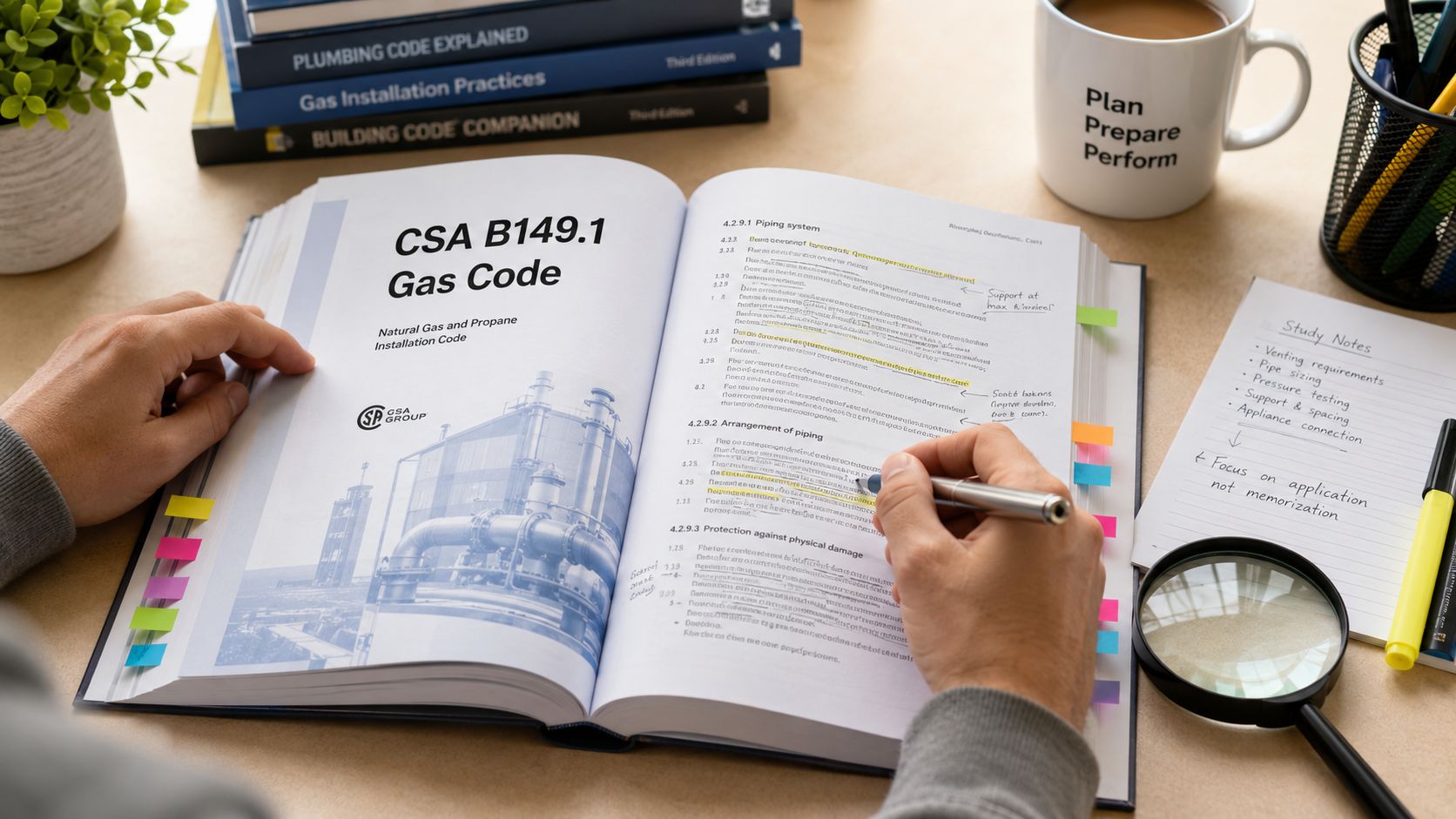
If you're preparing for a TSSA gas exam, the code book needs to become physically familiar. You should know where the major sections live, how the index behaves, and how fast you can move from a question to the right clause family.
That means working with the book in your hands. Tabbing major areas helps. So does building your own quick-reference markers for topics that keep coming up in practice questions. Don't overdo it. If every page is flagged, nothing is flagged.
A useful system is to mark by function, not by random chapter order:
- **Definitions and general requirements**
- **Piping and pressure material**
- **Venting and air supply**
- **Appliance-specific sections**
- **Tables and appendices you regularly use**
<a id="a-practical-way-to-train-with-the-book"></a>
A PRACTICAL WAY TO TRAIN WITH THE BOOK
The best code study I've seen starts with questions, not passive reading. Work a question, commit to an answer, then prove it in the code. If you're wrong, find out exactly where your reasoning broke down.
That's how candidates get faster. They stop seeing the code as a wall of text and start seeing repeated pathways. If you want structured practice aimed at Ontario entry-level prep, the [Ontario G3 gas fitter exam prep materials](https://flamepath.co/g3-gas-fitter-exam-prep-ontario) are one practical way to build that lookup habit.
> **Study habit that works:** answer the question first, then force yourself to locate the supporting clause even if you got it right.
Here's a method that works well:
1. **Run short practice sets** so you don't burn out.
2. **Look up every uncertain answer** instead of relying on recall.
3. **Write down clause locations** for the topics you keep missing.
4. **Repeat weak areas** until the search path becomes automatic.
<a id="what-does-not-work"></a>
WHAT DOES NOT WORK
Reading the book front to back without applying anything is insufficient preparation for exam conditions. Neither is highlighting half the page and calling it studying.
What works is repetition with purpose. Find. Verify. Correct. Repeat.
If you do that often enough, the code book stops feeling intimidating. It starts feeling familiar, and that familiarity is what buys you time and confidence when the clock is running.
<a id="accessing-the-code-and-final-exam-prep-tips"></a>
ACCESSING THE CODE AND FINAL EXAM PREP TIPS
A candidate walks into the test with a clean binder, good notes, and the wrong edition of B149.1. By question ten, the problem starts to show. In Ontario, that mistake is bigger than a study issue. It is a code, regulation, and enforcement issue.
<a id="get-the-right-edition-first"></a>
GET THE RIGHT EDITION FIRST
Use the edition your training provider and exam prep are built around, then confirm it lines up with what is enforced in Ontario. B149.1 is the technical code. O.Reg. 212/01 gives the legal frame in Ontario. TSSA enforces that frame in the field and expects candidates to work from the version tied to current Ontario requirements.
That matters on exams for a simple reason. You are not being tested on gas knowledge in the abstract. You are being tested on the rule set as it is applied in this province.
Once you have the right book, choose the format you will use under pressure.
- **Physical copy:** better for tabs, margin notes, and page-location memory
- **Digital copy:** useful for quick review and keyword searches
- **Best choice:** the one you will practise with repeatedly, not the one that only looks convenient on day one
I tell apprentices the same thing every intake. If you study on paper and switch to screen at the end, or study on screen and try to tab a hard copy the night before, you slow yourself down.
<a id="final-exam-prep-that-holds-up-under-pressure"></a>
FINAL EXAM PREP THAT HOLDS UP UNDER PRESSURE
The last stretch should look like jobsite decision-making. Short time. Mixed topics. No perfect sequence.
Set up your prep that way. Run timed question sets. Check every miss against the code. Pay attention to whether the error came from bad recall, poor clause lookup, or misreading the question. Those are three different problems, and each one needs a different fix.
One more point matters in Ontario. If a question seems to sit between a code requirement and a provincial rule, train yourself to ask which document controls the situation. B149.1 gives the technical requirement. O.Reg. 212/01 and TSSA application tell you how that requirement is enforced here. Candidates who understand that hierarchy tend to make better choices on harder exam questions.
For a quick pressure test before exam day, use [Ontario gas exam quizzes and mock testing tools](https://flamepath.co/quizzes) to see whether your weak spot is code lookup speed, rule interpretation, or exam pacing.
Candidates who do timed, code-based practice usually show up calmer. They have already trained the part that matters most. Find the rule, confirm the clause, and move on.
<a id="your-final-step-to-tssa-exam-confidence"></a>
YOUR FINAL STEP TO TSSA EXAM CONFIDENCE
The code book isn't your enemy. It's the tool you'll use for the rest of your career if you stay in the trade. Once you understand how **CAN CSA B149.1** fits with Ontario Regulation 212/01 and TSSA enforcement, the whole system is easier to manage.
That's what good prep should do. It shouldn't drown you in theory. It should train you to find the right rule, apply it properly, and stay calm under exam pressure.
If you're serious about passing your G3, G2, or G1 exam in Ontario, use a prep system built around code-based practice, realistic mock exams, and direct feedback on mistakes. That's where candidates usually make the biggest jump. Not by reading more, but by training better.
---
FlamePath is built for Ontario gas fitter candidates who want practical TSSA exam prep tied to CSA B149.1 and Ontario requirements. You can start with the free readiness quiz, work through G3 modules, and use code-referenced practice questions, mock exams, and the AI tutor to tighten weak areas before test day. If you want a direct next step, visit [FlamePath](https://flamepath.co) and start training the way the exam tests.