HOW TO GET A GAS FITTER LICENCE IN ONTARIO: G3–G1
Get a gas fitter licence in Ontario: compare G3, G2 and G1 scopes, training and challenge routes, TSSA applications, and exam preparation.
**Short answer:** Ontario gas fitter certification has three main levels: G3 for entry-level work under supervision, G2 for equipment up to 400,000 BTUH input, and G1 for equipment at any input level. Choose the level that fits your experience, follow a training or eligible challenge route, and meet TSSA's examination and certification requirements. This guide explains the licence scopes, application steps and study preparation; FlamePath is an independent study tool, not a certification provider.
You're probably here because you opened the TSSA rules, saw G3, G2, G1, EX-9000, O. Reg. 215/01, CSA B149.1, and thought: fine, but what do I do first?
That's normal. A lot of good technicians, and career changers get stuck right there. The paperwork sounds bigger than the trade. It isn't. The gas fitter license Ontario path is straightforward once you strip out the bureaucracy and look at it like a working tech. Start with the licence level that matches your current experience, learn the code that applies to that level, pass the exam, and keep your hours and documents clean from day one.
There's also a choice not always clearly explained. You can go through a college-style training route, or you can challenge the TSSA exam if that path fits your background. For a lot of mechanically minded people, especially HVAC helpers, service guys, and career changers who already know how to study on their own, that second path is real. It just needs discipline.
If you're also weighing whether the trade is worth the push, it helps to look at the earning side and long-term progression in this field through this [Ontario gas fitter salary guide](https://flamepath.co/gas-fitter-salary-ontario).
YOUR ROADMAP TO A GAS FITTER LICENCE IN ONTARIO
In Ontario, gas licensing is controlled by the **Technical Standards and Safety Authority**, under **Ontario Regulation 215/01**. The system has three levels: **G3**, **G2**, and **G1**. TSSA is the issuer, and that matters because this isn't one of those trades where a shop can just decide you're qualified and send you out on your own.
The practical version looks like this:
1. **Get your entry point**. Individuals often start at **G3**.
2. **Learn your legal scope**. Don't guess what you can touch and what you can't.
3. **Pass the right exam for the licence level**.
4. **Work under the right supervision and log your experience properly**.
5. **Move up only when your hours, paperwork, and code knowledge match the next level**.
> **Practical rule:** Treat your first licence like a safety licence, not just a job ticket. If you build good habits at G3, the jump to G2 is cleaner, and G1 doesn't turn into a paperwork disaster later.
A lot of people overcomplicate the route because they mix up school, exams, and legal authority. Those are connected, but they're not the same thing. The school route can help you prepare. The exam proves competence. The certificate defines what work you're legally allowed to do.
For gas fitter license Ontario planning, the smartest move is to think in scopes. Ask: what equipment am I allowed to work on, under what supervision, and what experience do I need before the next jump? That keeps you focused on real trade progression instead of brochure language.
THE THREE TIERS OF ONTARIO GAS TECHNICIAN LICENCES
A lot of new techs hear G3, G2, and G1 and treat them like school levels. On the job, they decide what you can legally touch, what kind of calls you can take, and who has to stand beside you while you do the work. That is the part that affects your paycheque and your liability.
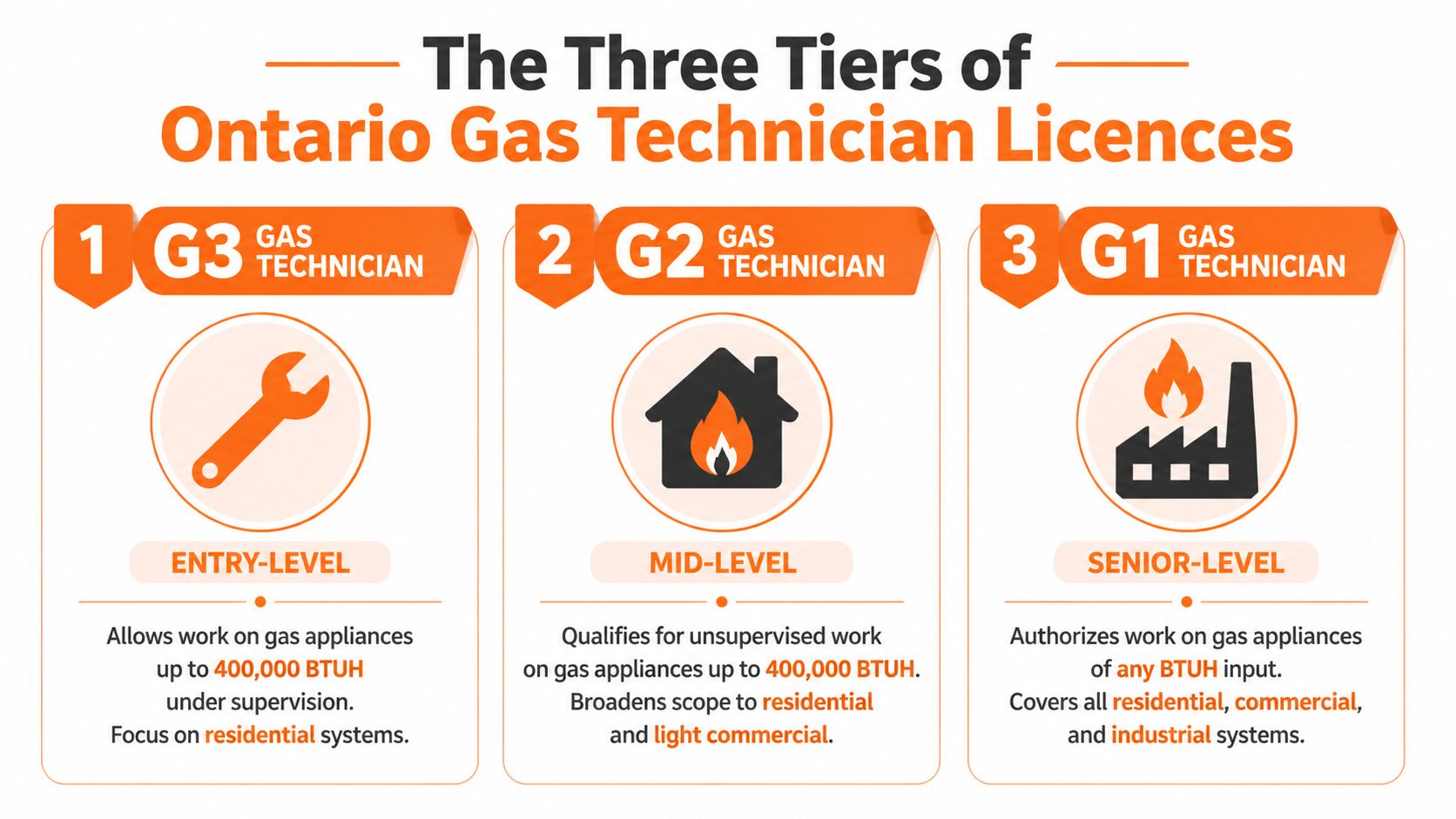
WHAT THE LICENCE LEVELS MEAN ON REAL JOBS
**G3** is the starting licence. It suits new entrants, helpers who want to formalize their experience, and tradespeople crossing over from HVAC, sheet metal, plumbing, or propane work. A G3 holder works under supervision and learns the habits that keep gas work safe: testing before firing, reading the appliance manual instead of guessing, checking venting details, and documenting what was completed. If you are weighing school against self-study, the primary comparison is structure versus flexibility, and this breakdown of the [online vs college gas fitter training path](https://flamepath.co/online-vs-college-gas-fitter) helps frame that decision.
**G2** is where a technician becomes broadly useful to most residential and light commercial contractors. This licence allows unsupervised work on gas-fired equipment up to 400,000 BTUH input, and it is the level many shops want on the truck because it covers the bread-and-butter calls: furnaces, water heaters, unit heaters, rooftop equipment within scope, piping changes, relights, conversions, and regular service work. A good G2 is not just passing an exam. A good G2 can read a wiring diagram, spot an unsafe vent connector in thirty seconds, and know when a small installation detail is about to turn into a callback.
**G1** is for full input work, including the larger commercial and industrial equipment that falls outside G2 limits. Getting there takes more than ambition. You need a valid G2, verified field experience, and time on larger systems under G1 supervision before you can write the exam. Shops do not hand that work to someone who only knows the code book in theory. They hand it to the technician who can walk into a mechanical room, sort out what matters first, and keep the job safe while everyone else is still staring at the piping.
That is why the TSSA exam challenge path matters. For someone with related field experience and the discipline to study properly, the exam is a legitimate way in. But the licence level still controls your scope. Passing the test does not replace trade judgement. It gives you the legal authority for the level you earned, then the field exposes any weak spots fast.
QUICK COMPARISON OF G3, G2, AND G1
| Licence | Exam | Real-world scope | Main progression requirement |
| --- | --- | --- | --- |
| **G3** | **EX-9000** | Entry-level gas work under supervision | Pass the qualifying exam and meet TSSA application requirements |
| **G2** | **EX-9001** | Unsupervised work on equipment up to **400,000 BTUH** | Hold the prerequisite licence or equivalent path accepted by TSSA, then pass the exam |
| **G1** | **EX-9002** | Work on gas-fired equipment at any input level | Valid **G2** plus verified field experience, including time on larger systems under **G1** supervision |
> Chasing G1 too early is a common mistake. Get there when your daily work actually includes bigger burners, commercial mechanical rooms, and the responsibility that comes with them.
There are also endorsements such as **GP**, **LP**, and **OP**. Those matter in the right niche, but for those navigating a gas fitter license ontario plan, the main ladder is still G3 to G2 to G1. Get that ladder straight first.
CHOOSING YOUR PATH TO G3 CERTIFICATION
There are two real routes to your first gas licence in Ontario. Both end at the same TSSA exam. How you get there depends on your situation, your timeline, and how you actually learn.
THE STRUCTURED TRAINING ROUTE
The college route puts you in a program with a set curriculum, timed delivery, and a structured path to the exam. George Brown, Humber, Lambton, Mohawk, and St. Lawrence all run gas fitter programs that align to TSSA requirements.
What you get: a paced study environment, access to instructors, lab time on actual equipment, and a built-in sequence that keeps you from skipping foundational pieces before you're ready. For people who need external accountability or who are newer to mechanical work, this matters. The downside is time and cost. Programs take months, and you're working around a schedule you don't fully control.
THE EXAM CHALLENGE ROUTE
If you already have trade background — HVAC, plumbing, steamfitting, propane, or time working alongside licensed gas techs — the challenge route is a legitimate option. TSSA allows eligible candidates to apply to write the licensing exam directly if they meet the experience and documentation criteria.
What you need: documented work experience, the right supporting records, and a study plan that treats the CSA B149.1 and Ontario Regulation 215/01 as the primary material. There's no shortcut through the code. You still have to know it cold. The difference is that you're building that knowledge on your own schedule, against the actual exam objectives, without the classroom structure.
For mechanically experienced people who are disciplined readers, this route is faster and cheaper. But it requires honest self-assessment. If you've never worked near gas equipment or you struggle to study independently, the challenge route will expose that fast. The exam is not easy just because there's no tuition attached to it.
A WINNING STRATEGY FOR TSSA EXAM PREPARATION
The TSSA gas technician exams are open-book. That misleads a lot of candidates. Open-book does not mean the exam is easier. It means the questions are written assuming you can navigate the code. If you don't know where things are and why, an open codebook is just a pile of paper under exam pressure.
STUDY THE CODE BOOK LIKE A TECH, NOT LIKE A NOVELIST
Don't read B149.1 from start to finish and expect it to stick. Work through it by topic cluster. Understand the logic behind each rule, not just the rule itself. When you get to venting requirements, ask: what is this section actually trying to prevent? When you get to pressure testing, ask: what is the failure mode we're protecting against?
That kind of thinking helps you answer scenario-based questions, not just definition questions.
BUILD A REPEATABLE PRACTICE CYCLE
Set a fixed window each day. Work through practice questions. When you miss one, don't just note the right answer — go back to the source in the code and read the full context. Then revisit that topic cluster at the end of the week.
Flamepath is built for exactly this kind of loop. It runs you through Ontario-specific practice questions, flags your weak zones, and lets you drill problem areas without grinding through material you already know. The G3 access is free if you want to see how it works before committing to anything.
THE WEAK SPOTS THAT FAIL GOOD CANDIDATES
Across candidates who struggle on gas fitter exams, a few topics show up repeatedly as the places where marks get dropped:
- **Combustion air calculations** — The formula itself isn't complicated. Getting the application wrong under pressure is where people fall apart.
- **Venting categories and configurations** — There are more combinations than most candidates expect, and the distinctions matter in the exam.
- **Leak testing sequence** — Candidates often know the phrase but not the sequence. If you don't understand the purpose of the test, you start mixing up steps.
- **Purge and activation procedures** — Rote memorisation is inadequate for these procedures. The exam wants safe order, not half-remembered jargon.
- **Piping and tubing sizing** — A lot of candidates are fine until numbers show up in a practical context.
A good prep routine keeps looping back to those weak zones. Read the rule. Answer questions on it. Miss one. Review it. Come back later and prove you still know it. That's what turns code knowledge into exam-ready judgement.
BOOKING YOUR EXAM AND MANAGING THE PAPERWORK
The exam itself is only half the job. TSSA paperwork can slow you down just as fast as bad study habits if you're careless.
WHAT TO PREPARE BEFORE YOU BOOK
For exam progression and certification, keep your documents organised before you touch the portal. That means your identification, your current certificate level, and any supporting records tied to the licence you're applying for.
For higher levels, especially G1, treat documentation like part of the exam. If your records are messy, incomplete, or signed off badly, you can lose time fixing preventable errors.
Use a simple checklist:
- **Current certificate status** — Make sure the licence level you already hold is valid and matches the next step you're applying for.
- **Work history records** — Keep dates, sites, equipment types, and supervising licence holder details clear and consistent.
- **Verification signatures** — Don't wait until months later to chase a supervisor for signoff. Do it while the job is still fresh and the details are easy to confirm.
- **Portal readiness** — Create your account details carefully and double-check names and identifying information before submission.
WHY HOUR LOGS MATTER MORE THAN MOST PEOPLE THINK
For the G2 to G1 jump, TSSA requires proof of at least **4,000 hours** of G2 work experience, including a minimum of **500 hours** on systems exceeding **400,000 BTUH**, verified by a supervising G1 holder. Incomplete or poorly documented logs are a primary reason applications get rejected, as set out in [Ontario Regulation 215/01 on gas technician certification](https://www.ontario.ca/laws/regulation/010215).
That's where a lot of competent techs get burned. They did the work, but they didn't document it properly.
A clean log should show:
- **What equipment you worked on**
- **Where the work happened**
- **When the work was performed**
- **Who supervised and verified it**
- **Whether the equipment fell into the higher input category required for G1 progression**
> If you wait until the end of your hours to reconstruct your experience from memory, you're making life harder than it needs to be.
Administrative mistakes are usually boring. They're still expensive. Keep your records current, legible, and signed. The best time to fix a log is the same week you did the job, not the month before your application goes in.
YOU PASSED THE EXAM — WHAT HAPPENS NEXT
Passing the exam gets you through the gate. It doesn't make you a finished technician.
WHAT EMPLOYERS CARE ABOUT AFTER THE PASS
Ontario employers still need licensed people badly. Demand for **NOC 72302 gas fitters** is high, some businesses are operating at reduced capacity because of shortages, and experienced licensed technicians are reporting strong salary benchmarks across the province.
That said, a fresh pass doesn't mean an employer expects you to know everything. They want to see whether you're safe, teachable, and reliable. A new G3 who shows up on time, follows procedure, and doesn't bluff is more valuable than a loud candidate who pretends to know what he doesn't know.
HOW TO USE THE LICENCE PROPERLY
Your first months after certification should be about tightening habits:
- **Ask questions before touching something you're unsure about**
- **Keep reading code in relation to the equipment you see**
- **Write things down**, especially model details, venting setups, and sequence issues
- **Protect your scope** and don't drift into work your licence level doesn't permit
A gas fitter license ontario credential creates opportunity, but it also creates responsibility. The licence says the province trusts you to work safely. Don't turn that into guesswork on site.
COMMON QUESTIONS ABOUT THE GAS FITTER LICENCE
WHAT IF I FAIL A TSSA EXAM?
You rewrite, but don't treat rewrites casually. Under **Ontario Regulation 215/01 Section 5**, a candidate who fails an exam **three times** at the same level must complete retraining before trying again. That rule exists for a reason. If you fail once, stop and figure out exactly where your understanding broke down.
DO I NEED A G1 FOR A SOLID CAREER?
Not always. Plenty of technicians build strong careers at G2, especially in residential and light commercial work. G1 becomes the right move when your work is pushing into larger commercial or industrial systems, or when you need that broader scope for the type of company or customer base you want.
CAN I CHALLENGE THE EXAMS WITHOUT COLLEGE?
Yes, that path exists. It's just poorly explained in most public material. The challenge route suits people who can study independently, already have some mechanical sense, and are willing to work through code the right way instead of hunting shortcuts.
WHAT ABOUT THE PROJECTED 2026 G2 ENROLMENT CHANGE?
There is a **new TSSA requirement effective January 1, 2026**, reported by HRAI, that will require **G3 certificate holders to complete specific training or experience before enrolling in G2**. If you're planning your upgrade path, treat that as a coming change and check the latest details through the [HRAI notice on the 2026 fuels G2 enrolment requirement](https://www.hrai.ca/newsletter/new-requirement-for-fuels-g2-enrolment-in-ontario--). Don't rely on old forum advice once that date gets closer.
---
If you're preparing for TSSA G3, G2, or G1 and want a cleaner way to study, [FlamePath](https://flamepath.co) is built for Ontario gas tech candidates who want targeted exam prep without enrolling in a college program. It's aligned to CSA B149.1 and Ontario Regulation 215/01, includes free G3 practice, full mock exams, mistake review, and an AI tutor on every question so you can work on the areas that are holding you back.