GAS BARBECUE INSTALLATION: TSSA G2 & G3 EXAM GUIDE 2026
Master gas barbecue installation for your TSSA G2 and G3 exams. Covers site assessment, clearances, tie-ins, pressure testing, and paperwork under Ontario code.
You're probably reading this with a code book open, practice questions on one screen, and a mental picture of a patio tie-in on the other. That's the right way to study gas barbecue installation in Ontario. This isn't a backyard hobby topic. It's a licensing topic, an inspection topic, and sometimes a discipline topic when someone cuts corners and gets caught.
For exam purposes, treat every gas barbecue installation as a full code exercise. You're expected to know when an outdoor appliance is just a portable cylinder-fed unit and when it becomes a fixed gas installation under Ontario rules. Once it's connected to fixed piping, you're in TSSA territory, under the **Technical Standards and Safety Act, 2000**, **Ontario Regulation 212/01**, and the applicable parts of **CSA B149.1** and **CSA B149.2**. Ontario requires fixed-piping gas barbecue work to be done by a certified **G3, G2, or G1 Gas Technician**, and improper appliance installations are a leading cause of gas-related incidents in Ontario.
A good apprentice usually loses marks in the same places. Clearance logic. Tie-in selection. Shutoff placement. Pressure testing sequence. Tagging and paperwork. None of that is difficult once you stop thinking like a homeowner and start thinking like the person whose certificate number goes on the job.
THE PRE-INSTALL WALKTHROUGH AND SITE ASSESSMENT
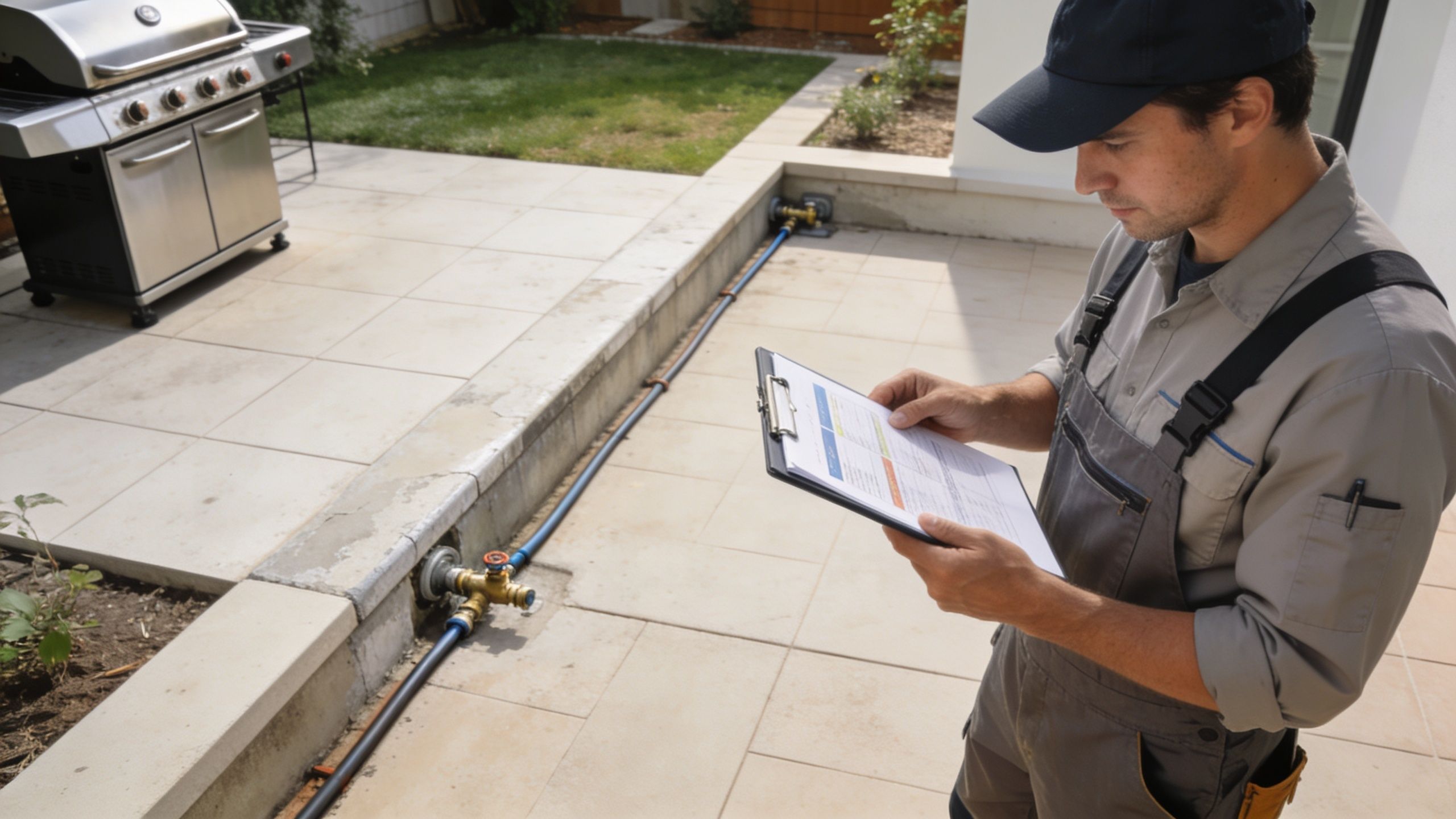
You pull up to a back deck for what the customer calls a "simple BBQ hookup." The grill is boxed, the patio furniture is in place, and the homeowner already picked the corner beside the sliding door under the soffit. That is how apprentices walk into failed inspections. The walkthrough decides whether the install is legal, serviceable, and worth starting at all.
START WITH WHAT MAKES THE INSTALL REGULATED
For exam purposes, sort the job before you touch a wrench. If the barbecue is connecting to fixed piping, a permanent outlet, or a built-in enclosure, you are in gas installation work governed by Ontario rules and the CSA B149 code framework. If you alter the gas system, add a branch line, install a valve, or terminate with a quick-connect, expect TSSA to treat it as regulated work.
That distinction matters because exam questions hide it in plain language. "Outdoor kitchen island." "Existing stub-out." "Customer wants a permanent natural gas connection." Those are not casual assembly calls. They trigger code duties, permit questions, and inspection risk.
Ask one question first: are you setting up an appliance, or are you installing part of a gas system? Get that wrong and the rest of the call goes sideways.
WALK THE SITE IN THE ORDER AN INSPECTOR WILL
A proper site assessment is not complicated. It is disciplined.
Start at the proposed appliance location and work outward. Check building openings near the operating position. Check what is overhead. Check adjacent combustible finishes and stored materials. Then trace the gas route back to the supply so you know whether the line can be installed with proper support, protection, shutoff access, and test access.
If the grill location is already bad, do not waste time planning a nice piping run to a bad location.
WHAT TO VERIFY BEFORE YOU UNLOAD TOOLS
Use a repeatable sequence on every barbecue call:
1. **Building openings.** Identify windows, doors, and mechanical air inlets near the appliance location. On the exam, they test whether you understand products of combustion, gas migration, and prohibited locations.
2. **Overhead exposure.** Look for soffits, balcony projections, roof structures, pergolas, and low combustible construction. A spot can be open on three sides and still be wrong if heat and flue products collect under an overhead surface.
3. **Combustible surfaces.** Check siding, guards, privacy screens, deck skirting, stored firewood, patio cushions, and anything the customer forgot was "temporary."
4. **Base and stability.** The appliance needs to sit level and stay level. A sloped paver corner or soft ground turns into a tipping hazard and a connector abuse problem.
5. **Gas route and valve access.** Confirm a practical path for piping or approved connection hardware. You need room for a shutoff, proper support, protection from damage, and access for future service.
6. **Appliance type and listing.** Verify whether the unit is portable, built-in, convertible, or field-converted already. The rating plate and manufacturer's instructions can kill the job before the first fitting comes out.
For the fuel-side differences you need to keep straight in exam scenarios, review [Ontario propane versus natural gas barbecue setups](https://flamepath.co/propane-vs-natural-gas-ontario). Do that before memorizing hardware details. The code path starts with the fuel and appliance category.
CLEARANCE MISTAKES FAIL JOBS FAST
Barbecue installs get rejected for basic judgement calls more often than for obscure clause errors. A unit jammed against vinyl siding, parked below a combustible overhang, or set where it operates beside an openable window tells the inspector the site was never assessed properly. In the field, those mistakes also lead to melted finishes, nuisance complaints, and liability nobody wants.
Manufacturer's certified clearances always matter. So does the site condition around the appliance in actual use. Customers love to say, "It fits there." Inspectors care whether it operates there safely and whether the installation matches code and the listing.
| Site item | What you're checking | Why it matters |
| --- | --- | --- |
| Building openings | Windows, doors, air intakes | Prevents gas entry and combustion product issues |
| Combustibles | Siding, fences, trim, railings | Reduces ignition risk and heat damage |
| Appliance type | Portable or permanently connected | Sets the code path and technician responsibility |
| Serviceability | Shutoff access, line routing, test access | Keeps the installation maintainable and inspectable |
A clean install is usually obvious from the walkthrough. So is a bad one. If the location forces compromises on clearance, valve access, connector routing, or future service, call it early and relocate the appliance before the bad decision gets buried behind finished work.
NATURAL GAS TIE-INS VERSUS PROPANE CYLINDER SETUPS
You walk into an exam practical, see a barbecue on a patio, and the first mistake is already sitting there. The apprentice treats it like "just a grill" instead of deciding which code path applies before touching a fitting. That habit fails inspections in the field too.
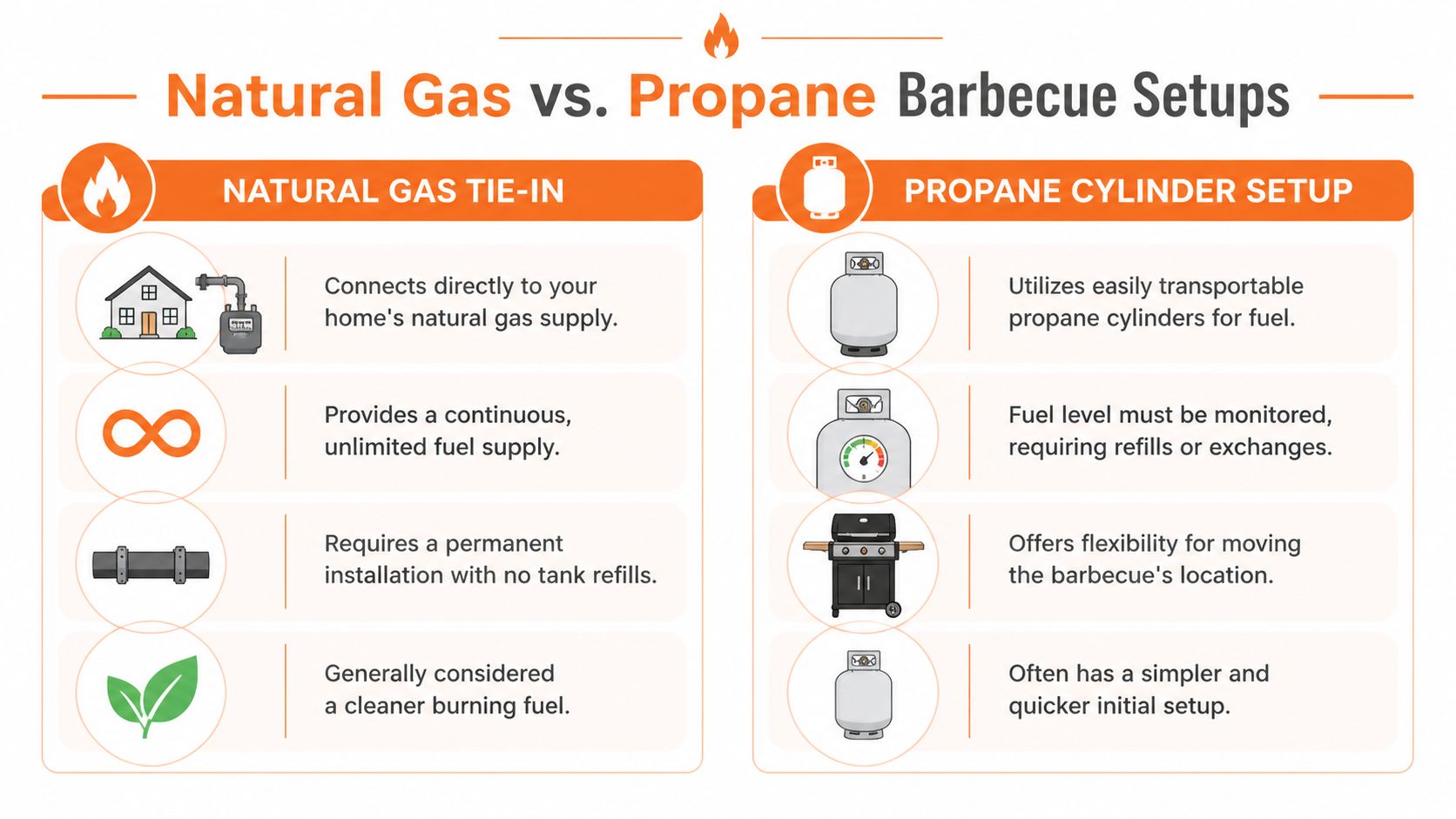
A natural gas tie-in and a propane cylinder setup can feed the same style of appliance, but they are not installed, tested, or defended the same way in front of an inspector. On the TSSA side, the exam keeps coming back to this because technicians mix up appliance conversion, connector selection, shutoff requirements, and storage rules.
NATURAL GAS TIE-INS
Natural gas work starts with the building system. That means the tie-in point, pipe sizing, valve placement, accessibility, and appliance certification all matter before the barbecue even gets assembled.
For exam purposes, remember the order of thinking. Confirm the appliance is certified for natural gas. Confirm the branch can supply it. Confirm the shutoff is installed where it can be accessed. Then confirm the outdoor connection method is approved for that appliance and location. Apprentices often reverse that order and start by picking a connector.
CSA B149.1 expects approved materials, accessible isolation, and an installation that can be serviced and tested without dismantling half the patio. If the branch line route creates strain on the connector, if the valve ends up buried behind the appliance, or if the tie-in depends on improvised adapters, the job is already headed toward a red tag.
Common field misses are predictable:
- Tying into a line without confirming capacity
- Installing a shutoff where the customer cannot reach it without moving the barbecue
- Using a connector to solve a piping layout problem
- Mixing natural gas and propane components because the threads fit
- Leaving flexible tubing unsupported or exposed to physical damage
That last one costs people marks. In the field, it costs callbacks. A connector is there to allow connection and limited movement, not to act as substitute piping.
PROPANE CYLINDER SETUPS
Propane changes the hazard profile because the fuel supply sits at the appliance. Now the technician has to think about cylinder location, vapour withdrawal, regulator arrangement, hose protection, and whether the installation is still a portable cylinder-fed appliance or has drifted into something more fixed and less defensible.
A standard cylinder barbecue built and connected exactly as certified is one thing. A cylinder tucked under a deck enclosure, fed through a modified hose route, with the regulator hanging where water collects, is something else. That is how simple patio jobs become exam questions.
For propane, apprentices usually lose marks in three places: they ignore cylinder placement, they treat the regulator as generic, and they forget that a quick-connect or hose assembly must be approved for the fuel, the pressure, and the application. CSA B149.2 comes up here often, especially where portable storage and connection details are tested.
Do not blur the line between portability and permanence. If the setup has fixed routing, concealed hose runs, altered regulator arrangements, or storage conditions that conflict with the certified design, an inspector will not care that the customer calls it "portable."
SIDE-BY-SIDE EXAM VIEW
| Issue | Natural gas tie-in | Propane cylinder setup |
| --- | --- | --- |
| Fuel source | Building gas piping system | Cylinder at the appliance |
| What the examiner is testing | Branch design, shutoff location, approved connection method | Cylinder use, regulator setup, hose routing, storage and placement |
| Common apprentice error | Treating the connector like piping | Treating the regulator and hose as interchangeable parts |
| Typical inspection failure | Inaccessible valve, poor tie-in choice, unsupported connector | Bad cylinder location, damaged hose routing, altered certified arrangement |
Natural gas gives continuous supply, but it ties the technician directly to the building gas system and all the code responsibility that comes with it. Propane gives mobility, but it adds cylinder handling and a shorter list of acceptable shortcuts. On the exam, choose the code path first. In the field, do the same.
ASSEMBLY AND CONNECTION BEST PRACTICES
Assembly work fails for small reasons. The examiner is looking for whether you understand connection types, support, clear access, and the difference between what is certified as an appliance component and what belongs to the piping system. If you blur those lines, you fail the question. On a live job, you buy the callback.
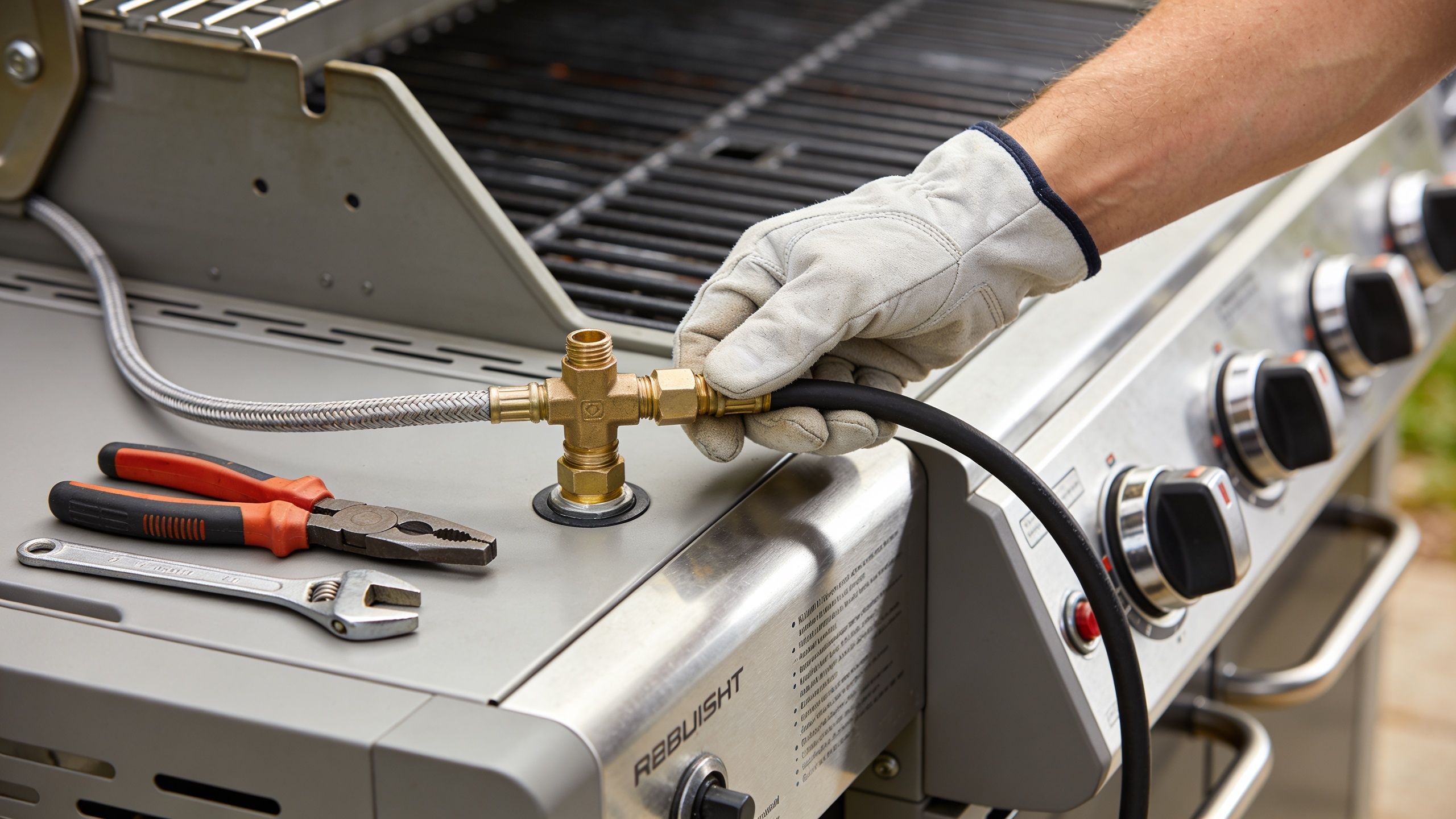
BUILD THE CONNECTION SO NOTHING IS UNDER STRAIN
Outdoor barbecue connections move. Lids slam, cabinets shift, hoses get pulled, and winter makes materials less forgiving. Build the line so the fitting does not carry load.
Support the piping run properly. Do not let an elbow, valve, manifold inlet, or quick-connect body act as a hanger. If the connector is taking the weight of the run, the assembly is wrong.
Keep the layout serviceable. A gas fitter should be able to identify the shutoff, disconnect the appliance, and test the assembly without emptying a cabinet or pulling stone veneer apart. Inspectors notice that right away.
GET THE JOINT TYPE RIGHT THE FIRST TIME
Use gas-rated sealant only where the joint design allows it. NPT threads may take approved compound or approved gas-rated tape, depending on the product and manufacturer instructions. Flare connections seal on the mating surfaces — the threads only draw the joint together. If you put dope or tape on a flare seat, you have already shown the examiner you do not understand the fitting.
Use two wrenches on flare assemblies and threaded transitions near appliance valves. One turns the nut or fitting. One backs up the fixed component. If you reef on a fitting with one wrench, you can twist the valve body or crack a manifold connection.
| Connection point | Correct practice | Common failure |
| --- | --- | --- |
| NPT threaded joint | Approved gas sealant where permitted | Excess compound, wrong product, or sealant on first threads fouling the system |
| Flare fitting | Clean mating faces, proper alignment, two-wrench tightening | Pipe dope on flare faces, cross-threading, overtightening |
| Appliance valve connection | Back up the valve body during tightening | Twisting the valve or manifold under load |
| Connector routing | Free of kinks, abrasion, and heat exposure | Hose dragged across sharp edges or hot firebox surfaces |
QUICK-CONNECT ASSEMBLIES ARE SIMPLE ONLY ON PAPER
Match the quick-connect and hose assembly to the fuel, capacity, and certified appliance arrangement. Put it where the hose will not kink, drag, rub on masonry, or sit against a hot surface. Leave enough movement for normal use, but not so much slack that the hose becomes a trip hazard or abrasion point.
For exam study, review the connector and hose provisions in [CSA B149.1 requirements for Ontario gas tech exams](https://flamepath.co/csa-b149-1-explained). Listed components stay within their listing, and field assembly cannot defeat that listing.
LEAK TESTING, COMMISSIONING, AND LOCKOUT PROCEDURES
This is the part of the job that can't be faked. An apprentice can bluff through material names or rough-in chatter. They can't bluff a proper pressure test, leak check, and commissioning sequence in front of an examiner or inspector.
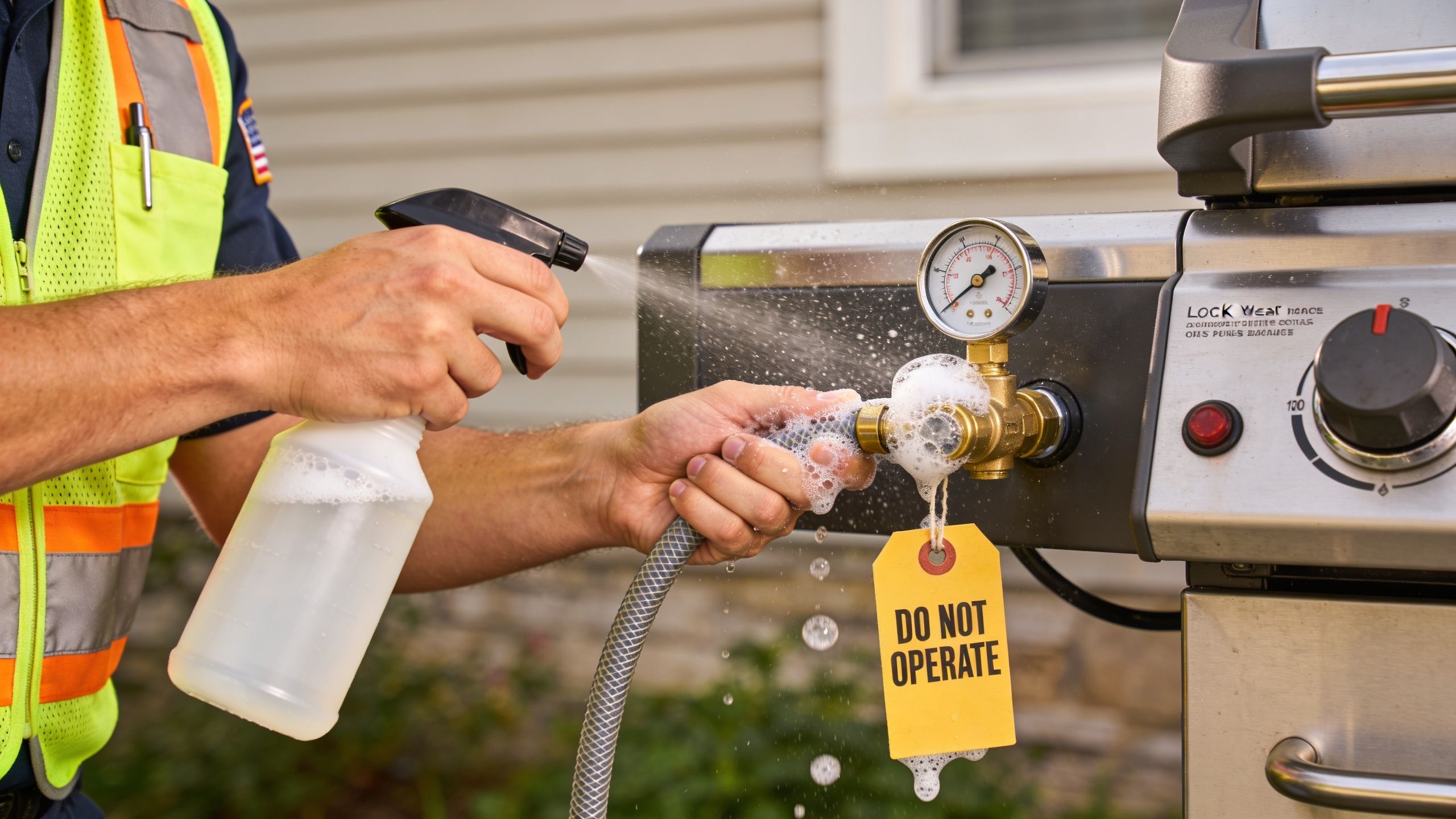
Treat pressure testing as a non-negotiable step, not a formality. For a deeper code-study breakdown, review [CSA B149.1 explained for Ontario gas tech exams](https://flamepath.co/csa-b149-1-explained).
TEST PRESSURE FIRST AND LEAK CHECK SECOND
Apprentices often reverse the sequence in conversation. Don't.
A **pressure test** proves the integrity of the isolated piping system. A **soap solution leak check** helps identify the exact leak point after assembly and during final verification. They are not the same test.
Use a clean sequence:
1. **Isolate the new piping section.**
2. **Connect the manometer or test gauge properly.**
3. **Bring the test section to the specified test pressure.**
4. **Hold for the required duration and watch for drop.**
5. **If the system holds, move to a point-by-point leak check on assembled joints.**
If the pressure falls, stop there. Don't light the appliance and hope the leak is minor. Find the defect, repair it, and restart the test sequence.
> Pressure testing tells you whether the system is sound. Soap bubbles tell you where it isn't.
COMMISSIONING THE APPLIANCE
Once the piping proves tight, commission the appliance like you expect someone else to review every step.
Purge air safely. Confirm ignition behaviour. Verify that burner operation is stable and consistent with the appliance design. Watch the flame. You're looking for normal ignition, proper carryover, and a stable burn pattern. Lazy flame, delayed ignition, or obvious imbalance means stop and investigate. Don't hand over a barbecue that "mostly lights."
LOCKOUT DISCIPLINE
Lockout habits matter more on shared systems than on isolated new work, but the discipline should be automatic on every gas barbecue installation tied into existing service. Shut down correctly. Identify the affected section. Prevent accidental re-energising while you work.
A rushed tie-in on an active system is how people skip pressure verification, miss a valve position, or assume zero pressure without checking. On the exam, that costs marks. In the field, it can cost much more.
MAKING IT OFFICIAL WITH TSSA PERMITS AND APPLIANCE TAGS
A legal install isn't just a leak-free install. It's also documented properly.
PAPERWORK IS PART OF THE INSTALL
Any gas barbecue installation tied into fixed piping should trigger the same professional thinking you'd bring to other regulated gas work. The administrative side exists for traceability. If someone asks who did the work, what was changed, and under whose certificate authority it was completed, the answer has to be clear.
Use this checklist after the physical work is complete:
- **Record the technician identity.** The name and certificate information need to be legible and complete.
- **Describe the work accurately.** "Installed BBQ line" is weaker than a clear description of the appliance connection or branch work completed.
- **Date the work correctly.** That matters for inspection trail and service history.
- **Tag the appliance or installation point properly.** Don't leave the record sitting in a van or pocket.
WHAT BELONGS ON THE TAG
A proper appliance tag should identify the installer, the relevant certificate authority, the work date, and what was done. Write it so another gas fitter can understand it without calling you.
| Tag problem | Why it causes trouble |
| --- | --- |
| Missing certificate number | No clear accountability |
| Vague work description | No reliable service history |
| Illegible writing or incomplete date | Weak inspection and audit trail |
If you wouldn't want to inherit the record later, don't leave it that way for the next technician.
COMMON TSSA EXAM QUESTIONS AND FIELD SCENARIOS
Exam questions on gas barbecue installation are usually testing judgement wrapped inside basic code facts. The wrong answer often sounds plausible because it matches what someone has seen on a rushed residential job.
SCENARIO ONE
A natural gas barbecue branch line is installed neatly, but there is no indoor shutoff and no outdoor shutoff near the appliance area. Is that acceptable?
No. CSA B149.1 requires that the installation include both indoor and outdoor shutoff valves for proper isolation and service access. The trap is that a single upstream valve may sound "safe enough." It isn't the expected answer. Isolation and service access both matter.
SCENARIO TWO
You inspect an outdoor line and see CSST hanging loosely behind the barbecue, with a visible bend where the unit is often moved for cleaning. What's the likely defect?
This is a support problem first. When the line isn't properly supported, movement and strain create kink risk and long-term leak potential. The best answer mentions support, protection from damage, and the fact that flexible materials are not a licence for careless routing.
> If the appliance movement is stressing the gas path, the connector layout is wrong even before it leaks.
SCENARIO THREE
A quick-connect is installed low to the deck, behind stored patio items, and the hose rubs against a rough edge during normal use. The connector is approved. Does approval alone make the installation compliant?
No. Component approval doesn't rescue poor placement. The exam wants you to think beyond brand labels and recognise serviceability, protection from damage, and practical safety during normal operation.
SCENARIO FOUR
You complete the piping, apply soap solution to accessible joints, and see no bubbles. Can you skip the formal pressure test because the leak check passed?
No. A soap test is not a substitute for a proper pressure test. The strongest answer explains the difference between proving the integrity of the piping section and checking individual assembled joints for visible leakage. The exam often rewards that distinction more than a memorised phrase.
A useful way to study these questions is to ask yourself what the inspector would write down in one sentence. Missing shutoff. Unsupported line. Poor connector location. No pressure test record. If you can state the defect plainly, you usually understand the code issue underneath it.
YOUR NEXT STEP TO G3 AND G2 CERTIFICATION
Gas barbecue installation is a good exam topic because it forces you to combine everything that matters in the Ontario trade. You need code recall. You need material knowledge. You need sequencing. You need enough field judgement to know when a convenient-looking install is still a bad install.
If you can reason through an outdoor tie-in, select the right shutoffs, support the run properly, test it correctly, and finish the paperwork, you're thinking like a technician who's ready for the licence.
If you're preparing seriously for the Ontario exams, use a study system that drills scenarios instead of just definitions. [FlamePath's TSSA G2 exam prep](https://flamepath.co/g2-exam-prep) is built for that style of preparation, with Ontario-focused practice that mirrors how code questions show up.
---
If you want targeted Ontario exam prep for G3, G2, or G1, study with [FlamePath](https://flamepath.co). It's built for TSSA candidates who want practice questions, mock exams, and code-based explanations that help turn field knowledge into a passing result.