G3 GAS LICENSE ONTARIO: YOUR PATH TO CERTIFICATION
Everything you need to know about getting your G3 gas license in Ontario. Covers scope of work, TSSA exam modules, college vs challenge path, timelines, and study strategy.
You're probably in one of three spots right now. You're an HVAC helper trying to get legal in Ontario. You're changing careers and every college page seems to explain the G3 licence differently. Or you've already heard from someone in the trade that the G3 gas license is "just the first ticket," but nobody has given you a straight answer on what it enables you to do.
Here's the plain version. In Ontario, the G3 is the front door into gas work. It's not a finish line. It's your entry credential, your learner-level licence, and the point where TSSA rules start applying to your day-to-day work in a serious way. If you don't understand the scope, the exam, and the path that fits your life, you can waste time, money, and a lot of energy going in circles.
This article is the roadmap most new techs should've been given on day one.
WHAT IS AN ONTARIO G3 GAS LICENSE?
You show up on a furnace change-out with your tools, your boots, and a fresh set of notes from class. Before you touch a gas valve, vent connector, or test gauge, one question matters. Are you licensed for the work you're about to do?
In Ontario, the G3 gas licence is the entry point into gas work. It is a TSSA-issued certificate under Ontario's gas technician licensing framework, and it puts you at the first rung of the ladder below G2 and G1. On the job, that means you are legally in the trade, but still in a training stage where supervision, code knowledge, and safe work habits matter every day.
A lot of new entrants get tripped up because they mix up three different things: a college course, a TSSA exam, and a licence. They are connected, but they are not interchangeable.
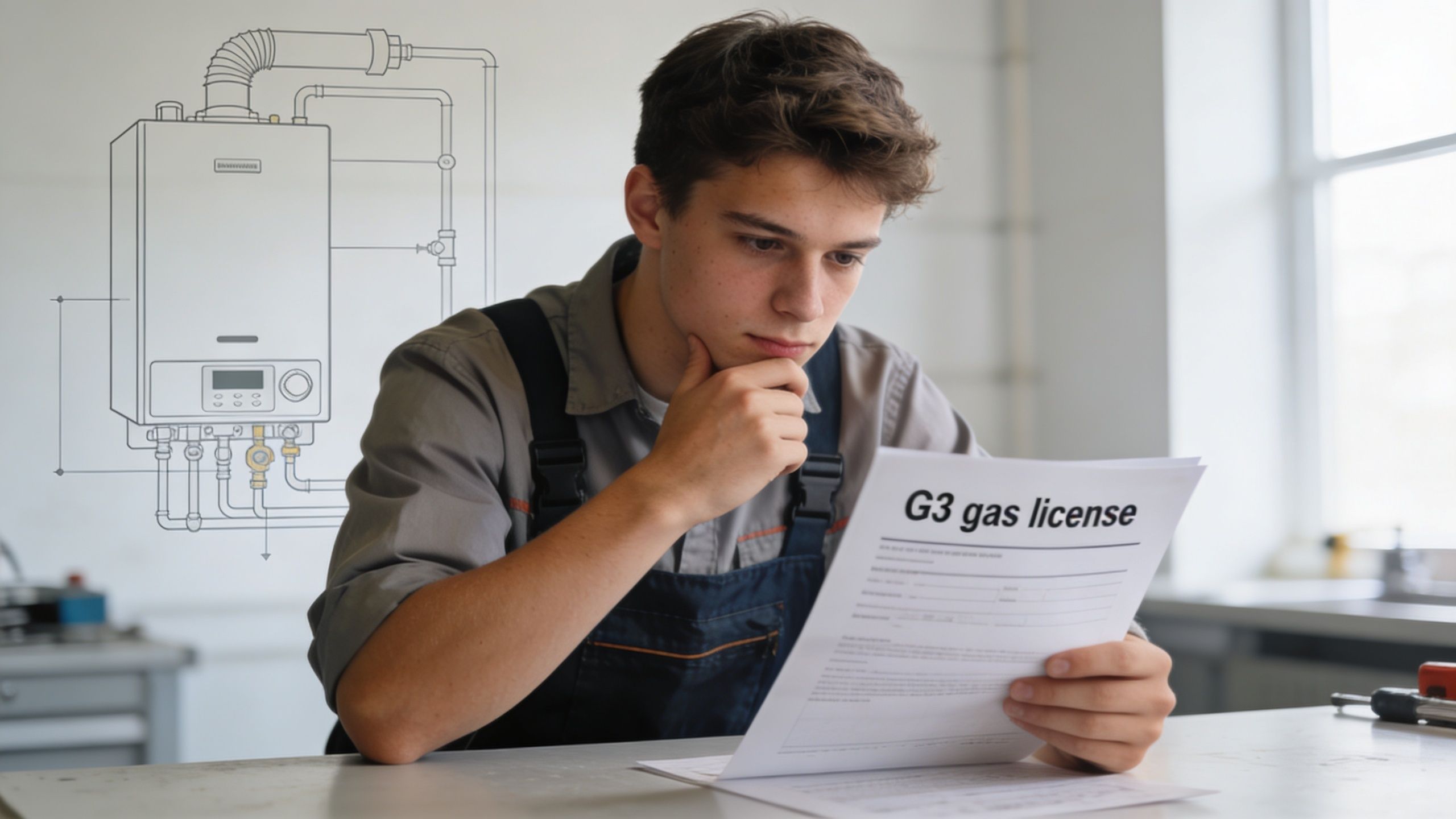
The practical definition is simple. A G3 licence lets you start working in the gas trade legally while you learn under a higher certificate holder. It tells employers, trainers, and inspectors that you have met the minimum licensing standard to enter the trade and start building field experience under the rules.
That matters more than many beginners realize. Gas work is not learned by memory alone, and it definitely is not learned by copying what the last installer did. CSA B149.1 sets the installation code. TSSA enforces the licensing and fuel safety side. If your piping, venting, clearances, combustion air, testing, or appliance setup are wrong, "someone showed me once" does not protect you.
WHERE G3 SITS IN THE TRADE
The ladder is straightforward:
- **G3** is the starting licence for legal entry into gas work
- **G2** expands your authority and field responsibility
- **G1** covers the highest level of gas technician work, including broader commercial and industrial applications
That ladder affects your day-to-day life on site. It decides who can take the lead, who can sign off, who can work with less oversight, and who is still there to learn the trade the right way.
One point causes more confusion than it should. Ontario has two legitimate ways people reach G3. Some go through a college or private training program. Others study the material, meet the requirements, and challenge the TSSA exam directly. The licence is still the same licence. The difference is how you prepared, what support you had, what you spent, and how much discipline you brought to the process.
If you want the bigger picture on the full trade progression, this [guide on how to become a gas fitter in Ontario](https://flamepath.co/how-to-become-a-gas-fitter-ontario) lays out the path clearly.
YOUR SCOPE OF WORK WITH A G3 LICENCE
A G3 licence gives you legal access to the trade, but it does **not** give you independent authority. That's the first rule to burn into your head.
Ontario's legal boundary is clear. Under [Ontario Regulation 348/96](https://www.ontario.ca/laws/regulation/960348), **Gas Technician 3 certificate holders are restricted to appliances with an input of 400,000 BTU/hour or less and must work under the direct supervision of a G2 or G1 technician**. If you miss either part of that sentence, you'll misunderstand the licence.
WHAT DIRECT SUPERVISION MEANS IN PRACTICE
On a real job site, direct supervision means you're not freelancing. The licensed G2 or G1 has to be actively supervising the work. This isn't a loophole where the licensed person is somewhere across town and reachable by phone.
If you're a G3 and you're piping a line, assisting with an appliance change-out, checking venting details, or helping with a start-up, your supervisor needs to be involved in a real and practical way. If there's a question about code application, combustion air, venting configuration, clearances, shut-off placement, regulator setup, or leak testing, the supervising technician is the one who carries that authority.
THE 400,000 BTU PER HOUR LINE MATTERS
This limit affects what kind of work you can even be around in a meaningful way. Many residential appliances and some light commercial equipment fall inside that boundary. Larger commercial and industrial systems can push beyond it, and once that happens, the G3 scope is no longer enough.
That matters for exam prep too. TSSA-style questions often test whether you can identify when something is inside your scope and when it has crossed the line. A lot of new people focus only on memorising code tables. They forget the first decision is often, "Am I even allowed to perform this work at my licence level?"
> If you can't identify when the appliance input or job conditions exceed your licence, you're already in trouble before you open the codebook.
HOW THIS LOOKS ON THE TOOLS
A G3 is useful on site. Don't confuse "restricted" with "useless." A good G3 can:
- **Assist with installs** on in-scope equipment while learning proper sequence and workmanship
- **Read the codebook** and flag issues before the lead technician has to fix them later
- **Handle prep work** like staging materials, tracing piping runs, confirming labels, and checking basic requirements
- **Learn diagnostic process** by watching how licensed technicians approach faults, pressures, safeties, and venting problems
What a G3 can't do is act like a solo gas fitter. CSA B149.1 should already be part of how you think at this stage — not as trivia, but as the book you use to confirm what the installation requires before the wrench comes out.
BREAKING DOWN THE TSSA G3 EXAM MODULES
A common mistake with the G3 exam is treating it like one big subject called "gas." It isn't. It's a bundle of related topics, and if you don't separate them, your weak areas stay hidden until exam day.
The smarter way is to break the exam into modules and tie each one back to actual field situations and the parts of **CSA B149.1** that matter.
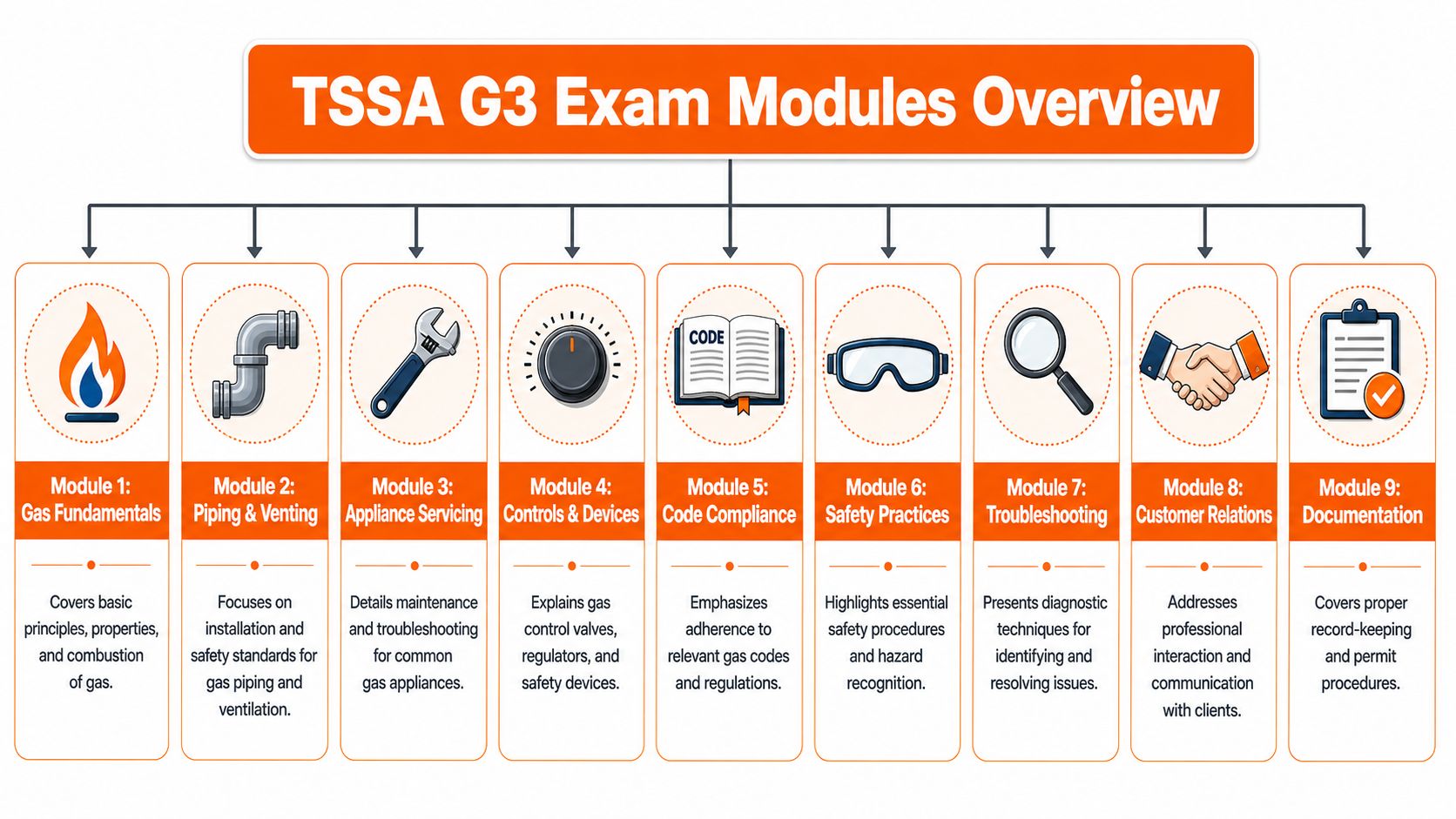
THE NINE AREAS YOU NEED TO OWN
1. **Gas fundamentals** — Combustion begins with these fundamentals. Gas properties, basic science, pressure concepts, and the behaviour of fuel are all introduced. If you don't understand what complete and incomplete combustion mean in plain language, later modules become harder than they need to be.
2. **Piping and venting basics** — This is bread-and-butter trade knowledge. Pipe sizing concepts, materials, installation practices, supports, shut-offs, vent categories, and termination rules all come back to code reading. In the field, this is the difference between a clean install and one that gets red-tagged.
3. **Appliance servicing basics** — At G3 level, nobody expects master-level diagnostics. They do expect that you understand components, basic operation, and safe service procedure. You should be able to follow the sequence of operation and recognise when something is off.
THE MIDDLE MODULES ARE WHERE MANY CANDIDATES GET SLOPPY
4. **Controls and devices** — Gas valves, regulators, limit devices, safeties, and operating controls matter because they keep systems from becoming dangerous. New candidates often memorize names without understanding function. That doesn't hold up under exam questions.
5. **Code compliance** — The CSA B149.1 shifts from background reading to your essential working reference here. You must understand how to locate answers rather than relying on memory. Many exam questions specifically test whether you can follow code logic under pressure.
6. **Safety practices** — Lockout habits, leak awareness, combustion hazards, spill risks, ignition sources, and safe work sequence all live here. This isn't a "common sense" section. It's a rules section.
> **Practical rule:** If a study method leaves you feeling confident but you still can't quickly find the relevant CSA B149.1 requirement, you're not ready.
THE LAST GROUP SEPARATES PREPARED CANDIDATES FROM PASSIVE READERS
7. **Troubleshooting** — Even at G3, you need a basic fault-finding mindset. Not random parts swapping. Process. Start with the complaint, confirm the condition, check the obvious, and follow the sequence.
8. **Customer relations** — Some new techs roll their eyes at this area. Don't. On site, how you speak to occupants, explain delays, or respond to a concern affects whether the day gets smoother or harder. Professional conduct is part of the job.
9. **Documentation** — Permits, records, notes, and job documentation matter because gas work has a paper trail. If something goes wrong later, vague memory won't help you.
HOW TO STUDY THESE MODULES PROPERLY
Use the modules as a checklist, not as labels. For each one, ask yourself:
- Can I explain it clearly?
- Can I apply it to a job-site scenario?
- Can I find the relevant code requirement?
- Can I answer questions on it without guessing?
The candidates who pass usually study by topic, test by topic, then circle back to full mixed practice. The ones who struggle often read notes in order, feel busy, and never find their weak spots until the exam exposes them.
TWO PATHS TO YOUR G3 LICENCE: COLLEGE VS CHALLENGE
You see this on job sites all the time. One helper signs up for a college program because he wants an instructor, shop time, and a set schedule. Another guy is already riding with a gas tech, handling tools, reading the codebook at night, and asking whether he can challenge the exam directly. Both are trying to get the same G3 licence. The right path depends on how you learn, what experience you already have, and how much structure you need.
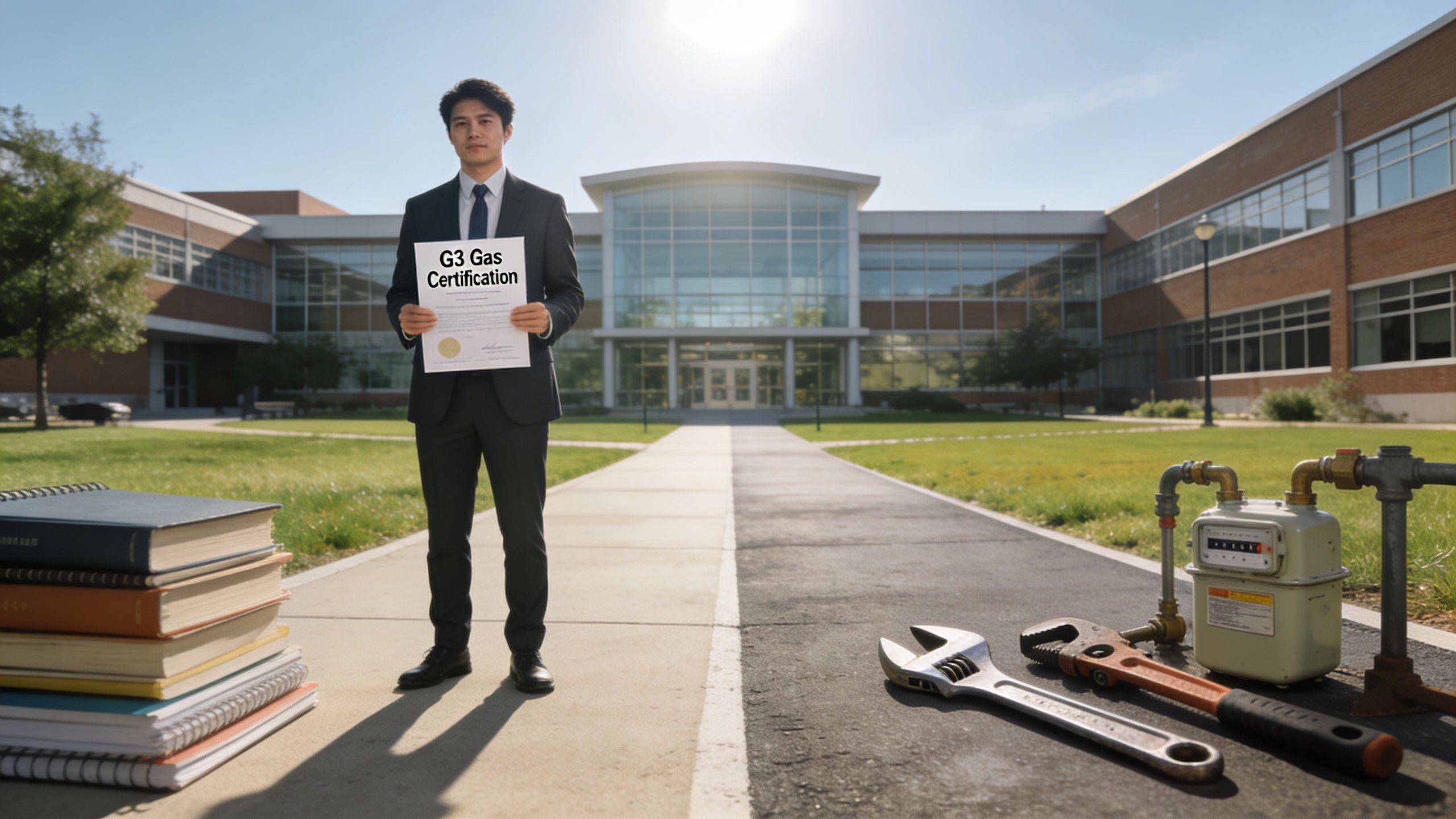
WHAT THE COLLEGE PATH GIVES YOU
The college route is straightforward. You get scheduled classes, instructor feedback, lab exposure, and a sequence that forces you through code, safety, controls, venting, combustion, and appliance basics in the right order.
That matters for green candidates. If you have never worked around gas piping, draft, regulators, or ignition sequence, structure usually saves time. It also cuts down on a common new tech mistake: reading a few chapters, feeling confident, then freezing on exam questions because you never learned how to apply CSA B149.1 rules to an actual installation scenario.
WHERE THE CHALLENGE PATH FITS
The challenge path is real, and a lot of people misunderstand it. Some candidates assume college is the only legitimate route because that is the route most schools advertise. In practice, the bigger question is whether you can meet TSSA requirements and show up ready for the exam standard.
Challenge usually makes sense for working adults, mechanical helpers, and people already getting exposure to the trade. If you spend your days around rooftops, unit heaters, furnaces, venting, and service calls, you already have a frame of reference for what the codebook is talking about.
A good breakdown of the regulatory side is in this guide to the [Ontario G3 open challenge path](https://flamepath.co/g3-open-challenge-ontario). Read it if you are hearing mixed answers about whether challenging the exam is allowed.
THE REAL TRADE-OFF
College gives you external structure. Challenge puts the burden on you.
That burden is heavier than many candidates expect. You need to build your own study plan, work through CSA B149.1 consistently, test yourself on modules you do not like, and fill in practical gaps without an instructor doing it for you.
The college path costs more and usually takes more calendar time, but it reduces guesswork. The challenge path can be faster and cheaper on paper, especially for someone already in the field, but it has a higher risk of wasted exam attempts if your preparation is sloppy.
WHICH ONE FITS YOUR SITUATION
Choose the **college path** if:
- You are new to gas work and need a proper foundation
- You learn better with deadlines, labs, and instructor correction
- You want guided exposure to code, controls, venting, and safety before the exam
- You know you study better when someone else sets the pace
Choose the **challenge path** if:
- You already work around licensed gas techs and can connect theory to real equipment
- Your schedule makes fixed class times hard to maintain
- You are disciplined enough to study CSA B149.1 on your own and verify what you think you know
- You understand that TSSA exams test code application, not just memory
REALISTIC TIMELINES AND COSTS FOR G3 CERTIFICATION
For G3 in Ontario, time and cost depend less on marketing language and more on three things: how much trade exposure you already have, whether you can study CSA B149.1 without supervision, and how expensive a failed attempt would be for your schedule.
| Expense / Factor | Traditional College Path | Self-Study / Challenge Path |
| --- | --- | --- |
| **Tuition and course delivery** | Higher total cost — paying for instruction, scheduled classes, and lab access | Lower formal training cost if you prepare on your own |
| **Exam and licensing fees** | Separate fees may still apply | You pay TSSA testing and licensing costs directly |
| **Books and code materials** | Sometimes bundled, sometimes extra | You need your own current codebook and study material |
| **Schedule** | Fixed class dates — better for candidates who need structure | More flexible on paper — that flexibility hurts people without discipline |
| **Timeline** | Usually slower on the calendar, but easier to predict | Can be faster if you already work around gas equipment |
| **Retake risk** | Lower for candidates who need guided practice | Higher if you guess at code interpretation or skip timed practice |
WHAT ACTUALLY STRETCHES THE TIMELINE
The slowdowns are usually practical, not academic:
- **Weak codebook use** — Knowing the rule is not the same as finding it fast.
- **Passive studying** — Reading notes feels productive but does not prepare you for exam pressure.
- **Bad assumptions about eligibility** — Some candidates hear that challenging is "not allowed" unless you go to college. That confusion wastes time.
- **Work and home logistics** — Shift work, childcare, commute time, and inconsistent study blocks can add months if you do not plan for them.
A REALISTIC BUDGET MINDSET
Budget the whole path, not just the seat fee. That means your training method, your CSA B149.1 copy, any prep material, travel, time off work, and the cost of a rewrite if you rush it. The cheaper route on day one can become the expensive route if you fail because your prep was half-done.
For candidates trying to keep costs under control, the smartest move is usually to price both paths in full, then compare them against your real schedule and experience level. A targeted [G3 gas fitter exam prep course in Ontario](https://flamepath.co/g3-gas-fitter-exam-prep-ontario) can cost less than a failed attempt plus another month of delay.
A WINNING STUDY STRATEGY FOR THE G3 EXAM
Most G3 failures come from the same bad pattern. The candidate reads notes, highlights half the page, flips through CSA B149.1, and tells themselves they'll "do practice later." That's backwards.

You pass this exam by forcing recall, finding weak spots early, and fixing mistakes until the right answer becomes repeatable. Reading has a place, but it's support work. Testing is the main event.
THE METHOD THAT WORKS ON REAL CANDIDATES
Start with diagnosis. You need to know which modules are weak before you decide what to study harder. Then move into tight practice loops:
1. **Test one module at a time** — Don't mix everything together on day one. Isolate a topic and see where your reasoning breaks down.
2. **Review every wrong answer properly** — Not just the correct choice. Ask why your choice was wrong, what clue you missed, and what code or principle should've guided you.
3. **Re-test the same weak area** — If you only review once and move on, the mistake usually comes back.
> The goal isn't to "cover" the material. The goal is to become hard to fool.
WHAT A PRACTICAL WEEKLY ROUTINE LOOKS LIKE
A simple study week is better than an ambitious one you won't follow.
- **Early week** — Spend short sessions on one or two modules. Keep CSA B149.1 open. Work slowly enough to understand the rule, not just the answer.
- **Midweek** — Do timed practice. Not marathon sessions. Timed sets force you to retrieve, decide, and move.
- **End of week** — Review your misses. Make a short error list. If you keep missing venting questions, stop telling yourself you "sort of know it." Go back and fix it.
WHAT DOESN'T WORK
A few habits sink candidates fast:
- Reading the codebook like a novel
- Memorising isolated facts without understanding application
- Avoiding timed questions because they feel uncomfortable
- Studying only favourite topics
- Assuming field exposure automatically equals exam readiness
If you want a focused prep option built around Ontario gas exams, [FlamePath's G3 gas fitter exam prep for Ontario](https://flamepath.co/g3-gas-fitter-exam-prep-ontario) gives candidates a way to drill weak areas, work through mock exams, and get explanations instead of just answer keys. That kind of targeted practice is a lot closer to what serious candidates need than passive review alone.
FAQS AND YOUR NEXT STEPS IN THE GAS TRADE
IS A G3 LICENCE ENOUGH TO GET A GOOD JOB IN ONTARIO?
A G3 licence is enough to get hired into the trade. It is not enough to treat yourself like a finished gas fitter. The better question is whether a G3 is enough to start building a career. Yes, if you use it as step one and keep your eye on G2.
CAN YOU BUILD A CAREER IF YOU TOOK THE CHALLENGE PATH INSTEAD OF COLLEGE?
Yes, if you know the material and can work safely. In the field, nobody gives extra credit because you paid more for training. They care whether you know what you are looking at. The licence is legitimate either way if you met TSSA's requirements and passed the exam.
HOW SOON SHOULD YOU MOVE FROM G3 TO G2?
Start planning for G2 as soon as you have your G3. Do not wait until you feel "settled." The G3 is designed as an entry point. If you stay there too long, your work options stay narrow and your learning can flatten out. Build hours. Stay close to licensed people who explain their decisions. Keep your codebook open. Then move.
WHERE SHOULD YOU LOOK FOR G3-LEVEL WORK?
Look for a shop that trains on purpose. Residential HVAC companies can be a strong starting point if they let you see installs, service calls, venting decisions, and commissioning work. Smaller contractors are often excellent training grounds when the lead tech is the type who answers "why" with a code reference instead of "because I said so."
Ask direct questions before you take the job. Who supervises G3 holders? Will you get field exposure or just shop work? Will anyone expect you to use the codebook? Those answers tell you a lot.
WHAT SHOULD YOU FOCUS ON IN YOUR FIRST MONTHS?
Start with habits that make a journeyperson trust you near gas equipment. Bring a notebook. Write down appliance model numbers, vent lengths, manifold pressures, and the section of CSA B149.1 that answers the question in front of you.
Speed can wait. Sequence matters more. On live equipment, the new tech who slows down, checks the manual, and confirms the code rule is worth more than the one who wants to look confident.
Respect your scope every day. If you are not licensed for the task, or you are not sure whether the task falls inside your authority, stop and ask. That is not weakness. That is how people stay safe and keep their licence.
> Good new techs are easy to teach. They listen, check the code, and do not make the same mistake twice.
---
If you are preparing for Ontario gas exams and want a cleaner path through the material, [FlamePath](https://flamepath.co) is built for exactly that. It gives G3, G2, and G1 candidates Ontario-focused practice, mock exams, readiness testing, and mistake review tied to CSA B149.1 and TSSA rules.