CANADIAN PLUMBING CODE FOR GAS TECHS: ONTARIO GUIDE
How the National Plumbing Code and Ontario Building Code intersect with CSA B149.1 on real gas jobs — condensate, traps, backflow, and the crossover questions that show up on TSSA exams.
You're on a job site in Ontario, the high-efficiency unit is hung, venting is nearly wrapped, and then the easy part turns into the inspection failure. The condensate has to drain somewhere. The nearby standpipe looks convenient. The floor drain is closer. The boiler loop has fill protection issues. Your journeyman asks what code book governs the tie-in, and if your answer is only CSA B149.1, you're already behind.
That's the gap a lot of G3, G2, and even G1 candidates run into. You study gas piping, venting, clearances, combustion air, appliance setup. Then the exam, or the inspector, hits you with the crossover stuff. Trap seals. Backwater valves. Drainage rules. Greywater separation. Condensate routing. The canadian plumbing code matters because gas equipment doesn't live in isolation. It dumps condensate, connects to water, interacts with drainage, and gets judged as part of a full mechanical system.
WHY A GAS FITTER NEEDS TO KNOW THE PLUMBING CODE
A furnace install can pass gas and still fail the job.
That catches apprentices off guard. They'll size the vent properly, support the connector, follow appliance instructions, and still get tagged because the condensate drain was treated like an afterthought. On paper it looks minor. On a real site, that one mistake can stop occupancy, trigger a callback, or force rework in a finished basement.
THE JOB SITE VERSION OF THE PROBLEM
Say you're piping a tankless water heater or a high-efficiency boiler. CSA B149.1 governs the gas side, the venting side, and appliance installation requirements. But once you start discharging condensate into a drain, tying into a fixture branch, or dealing with backflow protection on a fill connection, you've crossed into plumbing territory under Ontario's Building Code.
That's where candidates lose marks. They think in trade silos. The exam doesn't.
On Ontario work, the red tag usually shows up where one system touches another.
A good gas fitter learns fast that "not my trade" doesn't protect you when your appliance depends on drainage that's wrong. If the trap arrangement lets sewer gas into the space, if the drain tie-in is improper, or if the backflow side is missing on an interconnected system, the whole install is now your problem.
WHAT GETS YOU A PASS VERSUS A FAIL
The pass mindset is simple:
Read the appliance as a system. Don't stop at burner input and vent tables. Look at condensate, water, drainage, and overflow paths.
Know which code owns which detail. Gas venting and appliance installation live under CSA B149.1. Plumbing layout, traps, drains, and related protections fall under Ontario plumbing rules.
Expect crossover questions on TSSA exams. If a drain, trap, vent, or water connection is part of the appliance install, it's fair game.
A lot of apprentices want one clean answer from one book. That isn't how Ontario mechanical work goes. The clean install is the one that satisfies both codes without forcing the inspector to guess what you intended.
WHAT IS THE NATIONAL PLUMBING CODE OF CANADA
A gas fitter usually meets the plumbing code at the worst time. The appliance is set, gas is on, startup is close, and then someone asks where the condensate is draining, whether the connection needs a trap primer, or if that water makeup line needs backflow protection. If you do not know what sits underneath Ontario's plumbing rules, you are guessing.
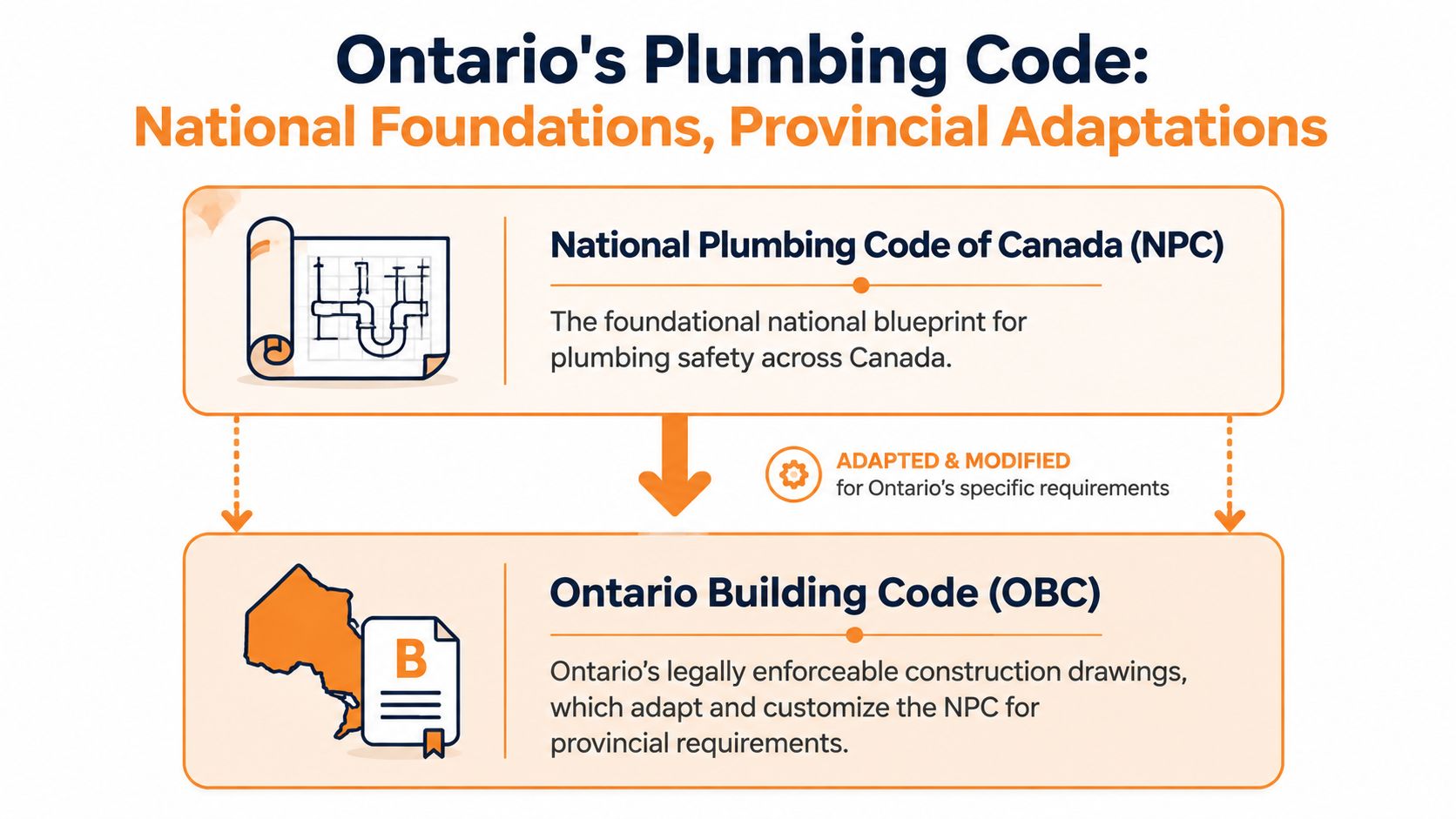
The National Plumbing Code of Canada, or NPC, is the model code Canada uses as the base document for plumbing requirements. It sets the national framework for how plumbing systems are designed, installed, altered, and repaired so the work controls health and safety risks such as contamination, sewer gas entry, cross-connections, and unsafe drainage arrangements.
For an Ontario gas fitter, that matters for one reason. A lot of the exam questions and inspection failures happen where gas work touches plumbing work. CSA B149.1 tells you how to install the gas appliance and venting. The plumbing side that supports that appliance often traces back to the NPC structure, then gets enforced through Ontario's version of the rules.
WHERE IT CAME FROM
The NPC started as the plumbing portion of the national building code and grew into its own code document so provinces had a common technical base instead of everyone inventing separate plumbing rules. That common base is why the language, layout, and intent behind plumbing provisions feel familiar across Canada, even when the enforceable provincial rules are different.
That history matters less than the habit it creates. Once you know the national model is the starting point, code hierarchy gets easier to read and exam questions get easier to sort out.
HOW THE CODE IS ORGANIZED
The NPC uses a three-part logic that helps on both the job site and the TSSA exam:
Objectives. The harm the rule is trying to prevent.
Functional statements. What the system has to do.
Acceptable solutions. Recognized ways to meet that requirement.
Read it that way and the code stops looking like trivia. A trap rule is about blocking sewer gas. A backflow rule is about protecting potable water. A drainage requirement is about keeping waste moving without contamination or overflow.
Job site rule: If you know the failure the clause is preventing, you are less likely to install something that passes one code book and fails the other.
That is the part general plumbing guides usually miss for gas fitters in Ontario. You do not need to memorize the NPC like a plumbing designer. You need to understand it well enough to spot when a gas appliance installation creates a plumbing obligation, especially on condensate disposal, indirect connections, trap protection, and water supply tie-ins. Those are the crossover points that show up on inspections and on TSSA exams.
HOW ONTARIO ADAPTS THE NATIONAL CODE
You rough in a condensing boiler, pipe the venting clean, pass your gas pressure test, and still get tagged on inspection because the drain connection was judged under Ontario plumbing rules, not the national model. That is the part apprentices miss.
Ontario uses the national plumbing code as a base, then rewrites and adopts it through the Ontario Building Code. On an Ontario job site, the enforceable wording is the Ontario Building Code, especially Part 7 for plumbing. The national text helps you understand the intent. It does not win the argument with the inspector.
THE BOOK THAT ACTUALLY RULES THE JOB SITE
A lot of exam candidates study from mixed material. One manual quotes the NPC. Another quotes Ontario amendments. A journeyman teaches from memory based on the last code cycle he worked under. That is how bad habits survive.
Ontario's current code cycle matters because the province adopted the newer national plumbing framework with Ontario-specific wording and enforcement context. For a gas fitter, that means one simple rule: if the installation is in Ontario, read the Ontario clause first, then check whether CSA B149.1 adds a separate gas requirement. If you want the gas-side crossover explained clearly, review CSA B149.1 exam prep for Ontario gas fitters.
WHAT ONTARIO CHANGES ACTUALLY MEAN FOR GAS WORK
Gas fitters do not need to become plumbing designers. They do need to recognize the points where an appliance installation creates a plumbing obligation, and Ontario may apply that obligation a little differently than the national model suggests.
Here are the areas that tend to matter on real installs:
Drainage and discharge connections — Condensate from high-efficiency equipment still has to enter the drainage system in a code-compliant way.
Trap and indirect connection requirements — A gas appliance drain can trigger trap seal, air gap, or indirect waste issues that B149.1 does not settle by itself.
Backflow and potable water protection — Tankless units, boilers, and fill lines can create cross-connection concerns once you tie into the water system.
Mechanical room layout rules tied to plumbing systems — Sumps, floor drains, and flood protection devices can affect where equipment gets installed and how service access works.
Ontario-specific acceptance in the field — An installer quoting only the national model can still fail if the Ontario wording is tighter or interpreted differently by the authority having jurisdiction.
The trade-off is practical. CSA B149.1 tells you how to install the gas appliance safely. The Ontario Building Code tells you whether the connected plumbing work is acceptable in that building. On paper, those books sit side by side. On site, the inspector can fail either side of the installation.
That is why the smart move is to stop treating plumbing as somebody else's problem. If your furnace, boiler, tankless, or water heater drains, fills, overflows, or ties into potable water, Ontario plumbing code is already part of your install.
CODE CONFLICTS GAS FITTERS FACE IN ONTARIO
A lot of inspection failures start the same way. The appliance is piped right, venting looks clean, gas pressure checks out, then the inspector follows the condensate or water connection and the job stalls.
CONDENSATE DRAINS ARE WHERE GUYS GET BURNED
High-efficiency furnaces, boilers, and tankless units cause this problem all the time. CSA B149.1 covers the gas side of the appliance. The moment that condensate has to discharge into a building drain, trapped receptor, or indirect connection, Ontario plumbing rules take over on that part of the install.
That split matters on the job site and on the TSSA exam. Candidates who only study the gas book usually miss the handoff point. A plain-language breakdown of CSA B149.1 crossover issues for Ontario gas exams helps if you keep getting stuck on mixed-code questions.
The usual fail is simple. A tech treats condensate like harmless water, ties it in wherever there is a nearby drain, and assumes the gas inspection will carry the whole install. It will not. Inspectors look at the connection method, the trap arrangement, and whether the discharge setup creates a plumbing violation even if the appliance itself is installed correctly.
MECHANICAL ROOMS CREATE CONFLICTS THE GAS CODE DOES NOT SETTLE
The hard part is that B149.1 does not answer every room-layout question once plumbing systems are involved. Put a new boiler or tankless unit into a basement mechanical room and you can trigger issues around floor drains, sump pits, backwater protection, and service clearance at the same time.
I see apprentices miss this in renovations. They focus on replacing the equipment and ignore the room conditions around it. Then the new appliance adds condensate, a relief discharge, or a water connection that changes what the inspector reviews.
Foundation drainage is another trouble spot. Ontario plumbing rules limit where that water can go, so an older basement layout that once passed may not be acceptable once the space is altered or new equipment is added. Gas fitters do not need to become full-time plumbers, but they do need to spot when the drainage strategy around the appliance is going to drag Part 7 into the conversation.
Sometimes the failure has nothing to do with the burner. The fail is the drain, the sump, or the way the room was tied together.
COMBO SYSTEMS RAISE CROSS-CONNECTION QUESTIONS FAST
Combi boilers, tankless water heaters with recirculation, and systems with fill lines create another common conflict. The gas code covers appliance installation and operation. Plumbing rules govern how potable water is protected once you connect that equipment to the building water system.
That is where exam questions get sneaky. You may get a short scenario about a fill connection, discharge point, or shared mechanical space, then have to pick the only answer that satisfies both books. If you read the question as gas only, you usually pick the wrong option.
WHAT INSPECTORS USUALLY CARE ABOUT
Inspectors in Ontario tend to zero in on the same practical misses:
Bad condensate tie-ins. The appliance works, but the drain connection is not acceptable.
Room conditions that changed with the new install. Existing sump, floor drain, or drainage arrangements get reviewed once new equipment is added.
Cross-connection risks. Water-side connections create plumbing issues that the gas code does not clear for you.
Assumptions about grandfathered work. "It was already there" does not help if the new appliance changes the compliance picture.
The apprentice question is usually, "Can I hook this up here?" The fitter question that gets a pass is, "Who owns this part of the install, gas code or plumbing code, and what else gets triggered if I connect it that way?"
PRACTICAL PLUMBING COMPLIANCE ON THE JOB SITE
You rough in a condensing boiler on a basement retrofit, the gas side is clean, startup goes fine, and the inspection still turns ugly because the drain, trap, or venting detail was handled like an afterthought. That is how a lot of plumbing-related failures show up on gas jobs in Ontario. The appliance is fine. The connection to the drainage system is what gets tagged.
TRAP SEALS AND WHY THE NUMBER MATTERS
In the 2024 Ontario Building Code, Part 7 requires a trap seal depth of at least 38 mm.
On site, that number matters because trap protection is not a paperwork issue. It is what stops sewer gas from bleeding back into a mechanical room after a few weeks of appliance operation, intermittent drainage, or a poor tie-in. Gas fitters run into this with condensate disposal all the time, especially where someone tries to use an existing floor drain, a standpipe, or a receptor that was never set up with the new appliance in mind.
The trade-off is simple. Using what is already in the room saves time. It also creates inspection risk if the trap seal, trap arm, or venting arrangement is wrong. Ontario inspectors do not care that the boiler fired properly if the drain connection leaves the plumbing side vulnerable.
A SHORT FIELD CHECKLIST
Use this on jobs where gas equipment meets drainage:
Confirm the trap seal depth. If it does not maintain 38 mm, fix it before close-in.
Look at the trap arm, not just the trap. A sloppy run, bad grade, or overlong arm can turn a decent-looking connection into a siphonage problem.
Check how the condensate enters the system. The discharge point has to work with the plumbing layout, not just reach it.
Watch for abandoned or rarely used drains. A legal drain on paper can still dry out and create a sewer gas complaint.
Read the whole install as one system. Gas code may govern the appliance, but once you tie into sanitary or storm components, plumbing rules can decide whether the job passes.
That last point is where apprentices get burned on tests and on site. They answer the gas question and miss the plumbing failure built into the same scenario.
WHERE AAVS HELP AND WHERE THEY DO NOT SAVE YOU
Air admittance valves show up in retrofits for one reason. Space is tight. Old framing is ugly, vent routing is limited, and the installer wants a clean way to handle fixture venting near new mechanical equipment.
Used properly, an AAV can solve a real layout problem. Used poorly, it just hides one.
Ontario fitters should be careful here because exam questions and inspection deficiencies often turn on details the gas book does not cover. The Ontario Building Code allows AAVs only in specific applications and with specific installation conditions under Article 7.5.9.2. If the valve is buried, inaccessible, installed in the wrong location, or treated like a substitute for proper system design, expect trouble.
The field rule is blunt. An AAV can help vent a fixture. It does not fix a bad condensate disposal plan, a weak trap arrangement, or a drainage layout that was wrong from the start.
Small mechanical rooms are where this overlap shows up most. The gas fitter sees venting clearances, service access, combustion air, and appliance drain requirements. The plumbing inspector sees trap protection, venting method, accessibility, and whether the connection belongs there at all. If the install only works because one detail got ignored, it is not a pass.
HOW PLUMBING CODE AFFECTS YOUR TSSA EXAM
TSSA exams don't test whether you can recite a book. They test whether you can make a safe call when systems overlap. That's why plumbing shows up even when your licence says gas technician.
A lot of candidates miss this because they study by chapter instead of by scenario. The exam doesn't care that condensate drainage feels like somebody else's lane. If a gas appliance needs that drainage to operate safely, it's part of your lane.
WHAT EACH LICENCE LEVEL TENDS TO TEST
The style changes by level, but the crossover issue stays:
G3 tends to hit fundamentals. Basic drainage awareness, obvious trap or vent mistakes, and whether you know that appliance discharge can trigger plumbing rules.
G2 usually pushes deeper into residential system interaction. Tankless water heaters, boilers, backflow concerns, condensate disposal, and mechanical room details.
G1 expects you to sort out complex installs where gas, plumbing, and building requirements collide in larger or more specialised systems.
HOW TO ANSWER CROSSOVER QUESTIONS
When you see one of these on an exam, use a trade sequence:
Identify the appliance. Furnace, boiler, tankless, water heater, rooftop, whatever it is.
Spot the non-gas connection. Drain, trap, fill line, vented receptor, sump-related condition.
Ask which code gets triggered. CSA B149.1 covers the gas install, but Ontario plumbing rules may control the connection detail.
Eliminate answers that solve only half the problem. A technically correct gas answer can still be wrong if the drainage arrangement is non-compliant.
The exam likes answers that look good to one trade and fail the other. Don't bite on those.
The strongest candidates don't just know clauses. They recognise inspection-failure patterns. If a question smells like condensate, backflow, trap seal, or drainage tie-in, slow down. That's usually where the marks are.
ACCESSING CODES AND PREPARING FOR YOUR EXAM
Most candidates waste time trying to memorise too much and working through the code too little. On the job and on the exam, you need to know where the rule lives and how to find it fast.
WHAT TO PULL FIRST
Start with the documents that control your Ontario work:
National model background. The NRC Publications Archive provides access to the national code material, with print options also available through official channels.
Ontario Building Code. This is the enforceable book for plumbing work on Ontario jobs.
CSA B149.1 and Ontario Regulation 212/01. These govern the gas side and licensing framework you're being tested on.
Don't study these like novels. Study them like maps.
HOW TO STUDY WITHOUT GETTING BURIED
A better method is to build your prep around recurring field situations:
Condensate disposal from high-efficiency equipment
Trap, vent, and receptor issues in basements
Backflow and water connection questions on boilers and combo systems
Mechanical room layouts where plumbing and gas rules clash
Then test yourself under exam conditions. FlamePath helps Ontario gas fitter candidates prepare for G3, G2, and G1 exams with focused practice built around CSA B149.1, Ontario regulation, and the crossover problems that trip people up on real TSSA tests. Every module is free — run a readiness check, and see where your weak spots are before you book the exam.