ONTARIO GAS CODE EXPLAINED FOR G3/G2/G1 EXAMS
How the Ontario gas code applies on real jobs and on TSSA G3, G2, and G1 exams — legal framework, key CSA B149.1 sections, common traps, and a smarter study path.
You've probably got the code book open on one side, a notebook on the other, and a practice question in front of you that looks simple until the wording turns sideways. That's where most Ontario gas fitter candidates lose marks. It's usually not because they've never seen the topic. It's because they don't yet see how the ontario gas code is applied on a real job, and how TSSA likes to test that application.
The fix isn't memorising random clauses. It's learning the legal chain, the high-value code sections, and the field scenarios that show up again and again on G3, G2, and G1 exams. If you can read a question and quickly sort out authority, scope, safety intent, and the practical next step, you're in much better shape both for the exam room and for the truck.
TABLE OF CONTENTS
Why the Ontario Gas Code is Your Most Important Tool
What the code really does for you
How apprentices should look at it
The Legal Framework Gas Technicians Must Know
The pyramid you need to remember
Why exam writers love this topic
What to do with that on an exam
Decoding Key CSA B149.1 Sections for Your Exam
Start with scope and responsibility
Piping questions are rarely just about pipe
Venting and combustion air are not the same topic
Bonding is easy to underestimate
Pressure and regulators need clean thinking
Your Core Obligations as a Certified Gas Technician
The four duties that follow you onto every call
How this shows up in the field
A practical checklist before you leave site
What doesn't work
Navigating 2026 Code Updates and Ontario Amendments
What this means for exam candidates
The study mistake to avoid
A simple way to frame update questions
Common Exam Traps and Field Mistakes to Avoid
The trench question trap
Other mistakes that keep showing up
The field habit that helps most
Your Study Path to Passing the TSSA Exam
WHY THE ONTARIO GAS CODE IS YOUR MOST IMPORTANT TOOL
A lot of apprentices first meet the ontario gas code the wrong way. They see a thick book, too many clauses, too many tables, and they treat it like something separate from the trade. That's a mistake. On the job, the code is as practical as your manometer, your leak test procedure, or your combustion setup. It tells you where your responsibility starts, what safe work looks like, and what won't pass inspection.
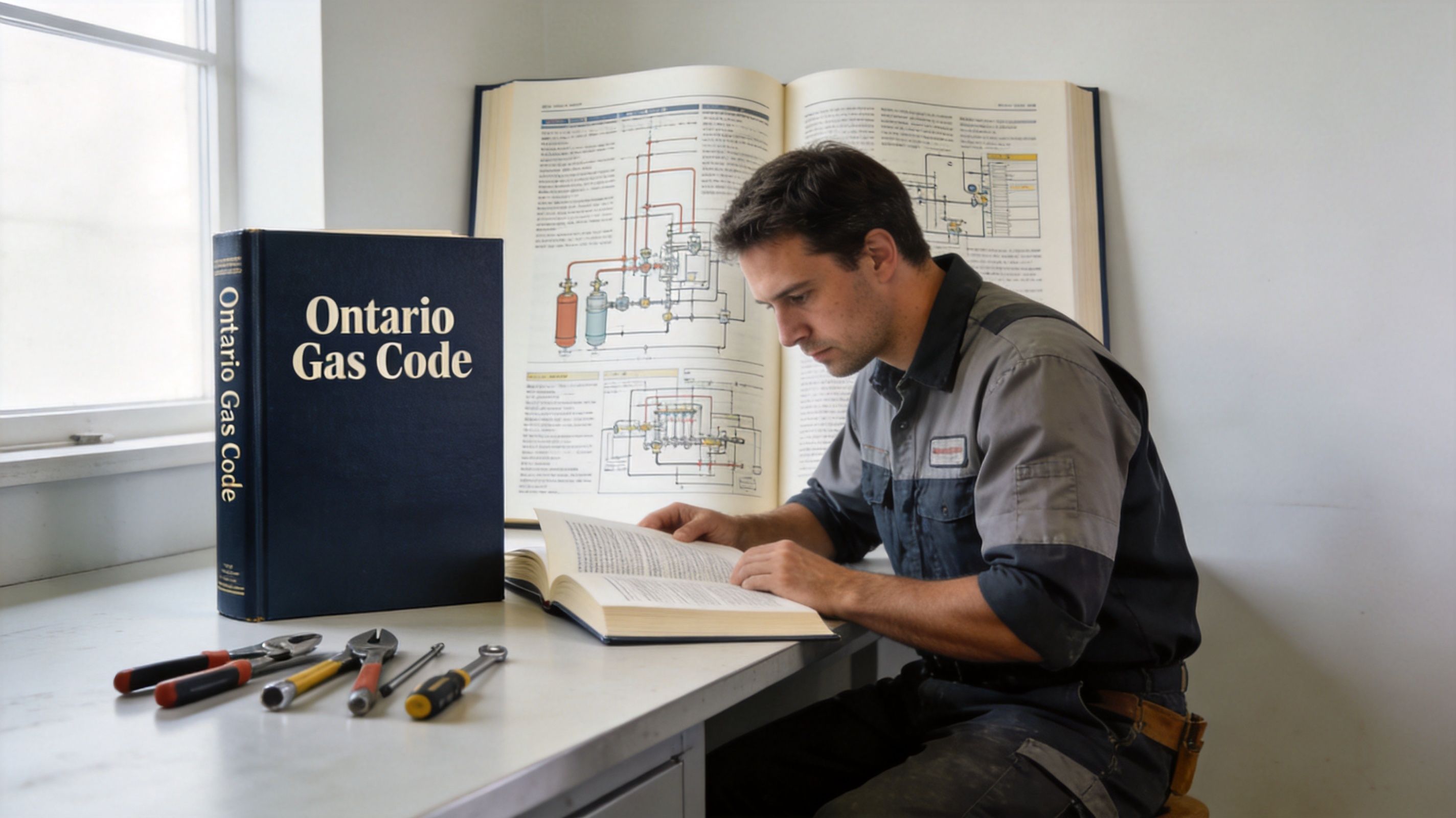
In Ontario, that code culture didn't appear out of nowhere. Ontario's energy history runs deep. The province's petroleum story started with the first commercial oil well in North America in 1858 in Oil Springs, a production legacy that feeds directly into today's safety framework.
WHAT THE CODE REALLY DOES FOR YOU
The code does three jobs at once:
It keeps people alive. Gas work goes bad unnoticed until it doesn't. Bad pressure, poor venting, or sloppy piping decisions can sit there waiting.
It protects your licence. If you're signing off on work, you need to know what standard applies and where your duty starts and ends.
It helps you pass exams. TSSA questions often test whether you understand the reason behind a rule, not just the wording.
A senior tech doesn't carry the code because he likes reading regulations. He carries it because sooner or later a job throws up something awkward. Mixed materials. Tight clearances. Existing work that was never bonded properly. An appliance replacement that looks straightforward until you realise the venting arrangement changes the whole call.
Practical rule: If you only study the code as trivia, you'll forget it under pressure. If you study it as jobsite decision-making, it sticks.
HOW APPRENTICES SHOULD LOOK AT IT
Don't try to memorise the entire ontario gas code cover to cover. Read it by task:
Job task — What to look for in the code
Running or altering piping — Scope, materials, support, bonding, pressure
Setting an appliance — Certification, clearance, connection, shutoff
Troubleshooting operation — Pressure, regulator logic, venting, combustion air
Preparing for inspection — Code authority, workmanship, documentation, defects
That shift matters. Once you start tying code to field actions, the book stops feeling like a barrier and starts working like a tool.
THE LEGAL FRAMEWORK GAS TECHNICIANS MUST KNOW
Most exam mistakes on law and code happen because candidates mix up legislation, regulations, and technical standards. They know CSA B149.1 is important, but they can't explain why it has legal force in Ontario. On a TSSA exam, that gap costs marks.
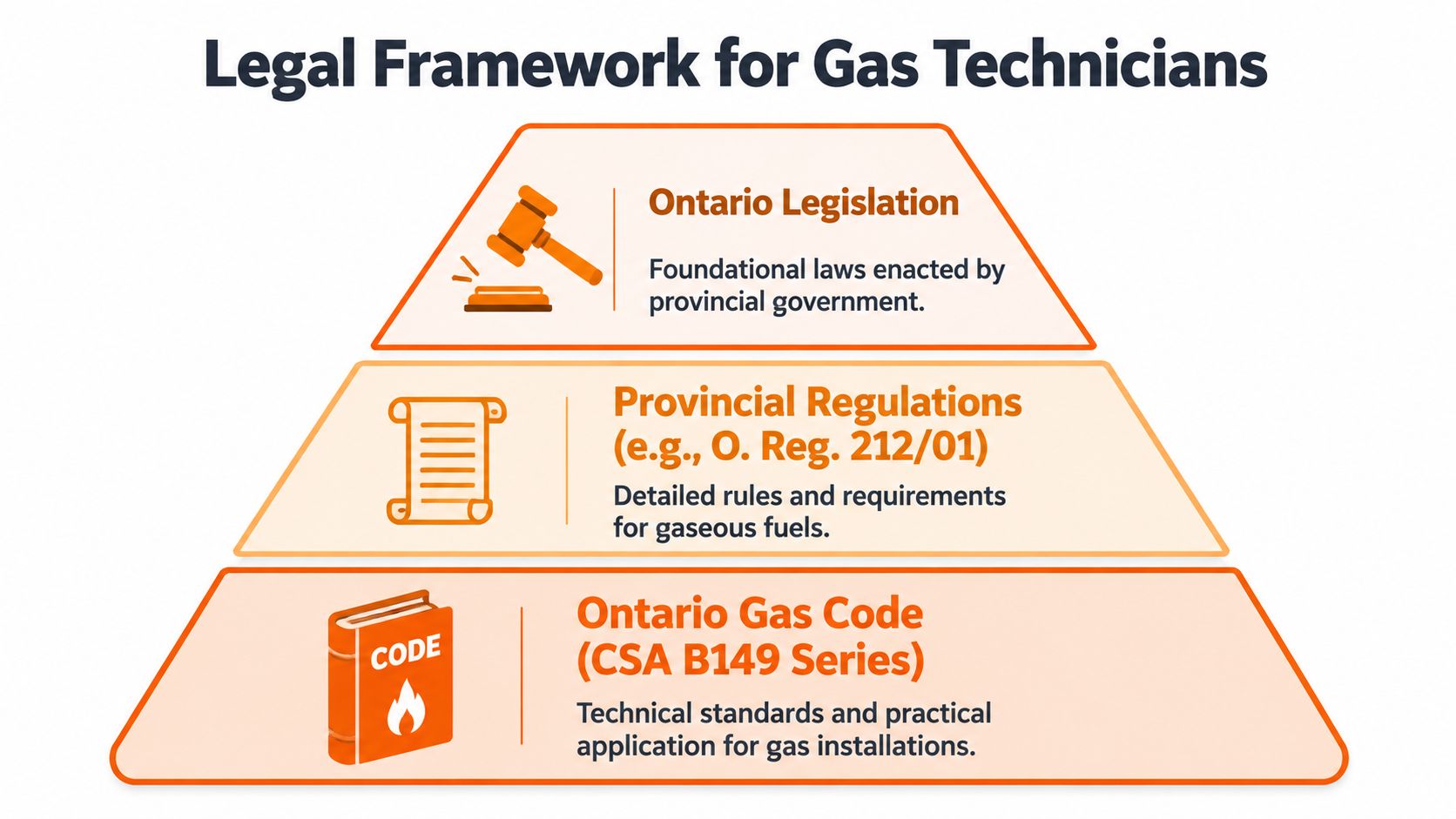
The easiest way to hold it in your head is as a pyramid. The higher you go, the broader the authority. The lower you go, the more technical and job-specific the rules become.
THE PYRAMID YOU NEED TO REMEMBER
At the top is Ontario legislation. That's the legal authority created by the province.
In the middle are provincial regulations, including the gaseous fuels rules that govern the trade.
At the base is the Ontario gas code, meaning the CSA B149 series as adopted and enforced through regulation.
That structure matters because the technical code doesn't float on its own. It becomes enforceable because Ontario adopts it through regulation. Ontario's broader model of province-wide codification goes back decades. The Ontario Building Code was enacted province-wide in 1975, replacing fragmented municipal requirements and establishing the idea of uniform provincial safety rules, as described in the history of Ontario's province-wide building code.
WHY EXAM WRITERS LOVE THIS TOPIC
This area is testable because it separates book readers from technicians who understand compliance. If a question asks who enforces, what document carries legal effect, or why an inspector can require correction, you need to think in order:
The province creates the legal framework
The regulation applies that framework to gaseous fuels work
CSA B149.1 supplies the technical installation rules
TSSA administers and enforces that framework
If you can't explain why CSA B149.1 is enforceable in Ontario, you don't fully understand the ontario gas code yet.
WHAT TO DO WITH THAT ON AN EXAM
When you get a legal-framework question, don't rush to the most familiar acronym. Sort the question first.
If it asks about legal authority, think legislation and regulation.
If it asks about technical installation requirements, think CSA B149.1.
If it asks about compliance oversight, think TSSA.
If it asks about licensing path and category structure, review the [Ontario gas fitter licence pathway](https://flamepath.co/how-to-become-gas-fitter-ontario).
A lot of apprentices study these as separate topics. Don't. Treat them as one chain. That's how the exam tests them, and that's how they show up in real work when an installation, inspection, and legal responsibility all meet on the same call.
DECODING KEY CSA B149.1 SECTIONS FOR YOUR EXAM
CSA B149.1 is big enough to bury you if you study it evenly. Don't. Some parts carry much more exam weight because they touch everyday installation work and high-risk decisions. For most candidates, the high-value ground is scope, piping, bonding, venting, and pressure responsibility.
START WITH SCOPE AND RESPONSIBILITY
One of the most important lines in the code is the one that defines where your responsibility begins. CSA B149.1 places the technician's responsibility downstream, specifically the piping system "extending downstream from the termination of the utility installation." That same standard also requires interior metal gas piping to be "electrically continuous and bonded."
That wording matters because exam questions often hide the underlying issue inside a service boundary question. If the problem is on the utility side, that's one answer. If it's downstream, it's in the gas technician's zone.
For candidates who want a clause-by-clause study companion, the [CSA B149.1 exam guide for Ontario candidates](https://flamepath.co/csa-b149-1-explained) is one way to organise those sections around test logic instead of reading the code in a straight line.
PIPING QUESTIONS ARE RARELY JUST ABOUT PIPE
On paper, piping questions look simple. In practice, they bundle several ideas together:
Material selection
Sizing
Support
Location
Pressure limits
Bonding
That's why they show up so often. One question can test whether you understand more than one code principle at once.
A candidate might focus on pipe size and miss the actual trap, which is bonding. Or they'll spot the regulator issue but ignore whether the piping arrangement remains within the installer's scope. That's how marks disappear.
The exam doesn't care whether you can recite a clause from memory. It cares whether you can identify the unsafe condition in a mixed scenario.
VENTING AND COMBUSTION AIR ARE NOT THE SAME TOPIC
Apprentices blend these together all the time. Don't.
Venting deals with getting products of combustion out.
Combustion air deals with getting enough air in for proper combustion.
Those are connected, but they're not interchangeable. A question might describe nuisance shutdowns, rollout, poor flame quality, or a space alteration after renovation. If you automatically jump to "venting issue" without checking the air side, you can land on the wrong answer.
Use this quick split:
Flue gas removal, vent connectors, termination path — Venting
Room volume, appliance air supply, confined space — Combustion air
Pressure at inlet or appliance performance under load — Gas supply or regulation
Stray electrical hazard or continuity issue — Bonding
BONDING IS EASY TO UNDERESTIMATE
The bonding requirement is one of those rules candidates memorise without respecting. Interior metal gas piping must be electrically continuous and bonded for a reason. In older buildings, alterations and pieced-together repairs can leave you with a piping system that isn't what the code intends. On an exam, that can appear as a fault-finding question. On a job, it can mean an installation that looks neat but isn't safe.
Bonding questions are strong exam material because they test whether you've moved past cosmetic thinking. A straight pipe run with clean joints can still be wrong.
PRESSURE AND REGULATORS NEED CLEAN THINKING
Pressure questions reward candidates who slow down. The code and regulation framework tie installation to exact operating conditions. If a question gives you symptoms, don't jump straight to the appliance. Work the chain:
Is the appliance certified and installed as intended?
Is the issue upstream or downstream of the utility termination?
Is the regulator arrangement appropriate?
Does the pressure condition fit the installation and operating context?
That method is slower when you're learning. It's faster when you're writing the exam.
YOUR CORE OBLIGATIONS AS A CERTIFIED GAS TECHNICIAN
Once you're licensed, the ontario gas code stops being study material and becomes daily duty. The basics are straightforward. Install correctly, inspect properly, document what you did, and act immediately when a condition isn't safe. Where people get into trouble is assuming these obligations are separate. They aren't. Each one supports the others.
THE FOUR DUTIES THAT FOLLOW YOU ONTO EVERY CALL
A licensed gas tech in Ontario works inside four constant obligations.
Installation must match the code and the appliance listing. A tidy install that ignores the listed requirements is still a bad install.
Inspection must be active, not casual. You're not there just to swap parts. You're there to judge whether the full system is safe to leave in service.
Documentation must be clear enough to stand on later. If someone asks what you found, what you tested, and what action you took, your notes should answer that.
Safety decisions must be immediate. If a condition requires action, delaying because the customer is unhappy isn't a defence.
HOW THIS SHOWS UP IN THE FIELD
A normal service call can force all four duties at once. You might arrive for a no-heat complaint and discover the reported problem isn't the main problem. Maybe the immediate issue is ignition, but the larger concern is venting, improper connection, or existing piping defects. That's when apprentices learn the difference between fixing a symptom and doing the job properly.
On the truck, your judgment matters as much as your wrenching. The code expects you to recognise when a system can stay in service and when it can't.
A PRACTICAL CHECKLIST BEFORE YOU LEAVE SITE
Use a mental close-out routine every time:
Appliance condition — Safe operation, proper connection, no obvious defect left unaddressed
Gas train and piping — No leaks, correct arrangement, no ignored safety issue
Venting and air side — System conditions support safe operation
Paper trail — Notes, tags, warnings, and follow-up actions completed
WHAT DOESN'T WORK
What fails in the field is usually one of these habits:
Tunnel vision on the complaint. You fix what the customer noticed and miss the code issue behind it.
Weak notes. "Unit checked" won't help you later.
Assuming old work is acceptable because it's existing. Existing doesn't automatically mean compliant or safe.
Avoiding a hard conversation. If a defect calls for action, you take action.
That's the professional side of certification. Passing the exam gets you in the trade. Handling these obligations properly keeps you there.
NAVIGATING 2026 CODE UPDATES AND ONTARIO AMENDMENTS
Code study gets harder when a standard is changing. Candidates preparing for G1 especially run into this because commercial and industrial questions often depend on newer language, revised details, and Ontario-specific amendments layered onto the national code.
The update to watch is Ontario's move to adopt CSA B149.1-2025 through the April 2026 amendment, with Ontario-specific changes included. Candidates preparing for G1 should pay particular attention to updates affecting commercial equipment access, serviceability, and installation requirements — these are areas where Ontario amendments have historically introduced local modifications on top of the national standard.
WHAT THIS MEANS FOR EXAM CANDIDATES
The first thing to understand is that code transition questions usually don't test trivia. They test whether you recognize that Ontario may adopt a standard with local changes layered on top. A candidate who studies only the base code can miss an Ontario-specific requirement entirely, and that's where marks disappear.
For G3 and G2 candidates, that can show up in simpler installation or safety framing. For G1 candidates, it hits harder because commercial equipment access, serviceability, and site-specific installation details show up more often.
THE STUDY MISTAKE TO AVOID
Don't study updates as a separate pile of notes called "new stuff." Tie them to the systems they affect.
Access opening changes belong with serviceability and equipment installation.
Cover or location changes belong with piping and protection.
Ontario-only tweaks belong with legal adoption and enforcement thinking.
That method makes exam recall easier because you're not trying to remember a detached amendment sheet. You're attaching each update to a familiar job task.
The candidate who passes update questions usually isn't the one who read the most. It's the one who sorted what changed, where it applies, and how Ontario modified it.
A SIMPLE WAY TO FRAME UPDATE QUESTIONS
When you see a code-update question, ask three things:
Is this asking about the national standard or Ontario's adopted version?
Does the detail affect installation, access, protection, or servicing?
Would this likely show up more at G3, G2, or G1 level?
That last question helps because not every change lands evenly across licence classes. A newer commercial-access rule may matter much more to a G1 candidate than to someone writing G3.
If you're writing in a transition period, confirm which code edition applies to your exam sitting. Don't assume. Ontario gas code questions are hard enough without studying the wrong adopted version.
COMMON EXAM TRAPS AND FIELD MISTAKES TO AVOID
The worst misses usually come from questions that sound like field common sense but hinge on one specific rule. Shared trench work is a good example. A candidate reads the question, imagines how the site usually looks, and answers from habit instead of code.
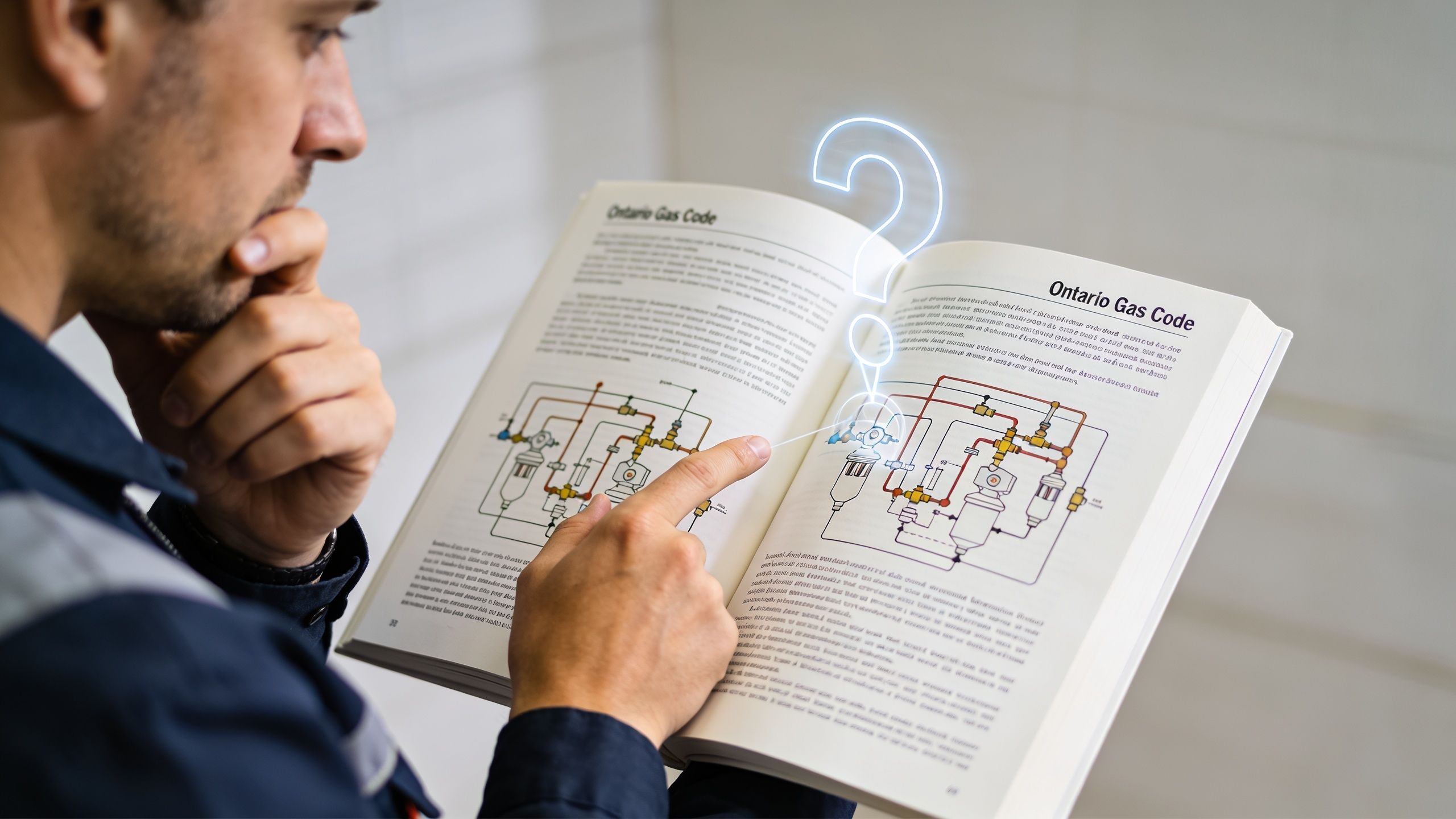
Under OESC Rule 12-012, electrical wiring can be installed in the same trench as gas services with 300 mm vertical separation, and where that clearance can't be achieved, you need to understand how mechanical protection is applied.
THE TRENCH QUESTION TRAP
Here's how apprentices usually get this wrong. They reduce the question to yes or no.
"Can electrical and gas be in the same trench?"
That's incomplete thinking. The exam question is usually closer to this:
Is it permitted?
What separation is required?
What if the required clearance can't be achieved?
Which protective measure keeps the installation compliant?
That's a very different question. Same-trench isn't the issue by itself. The issue is conditions of acceptance.
OTHER MISTAKES THAT KEEP SHOWING UP
A few patterns repeat across both exam rooms and jobsites:
Reading only the last line of the question — You miss the scope clue buried in the setup
Confusing venting with combustion air — You solve the wrong problem
Ignoring wording like "downstream" — You assign responsibility to the wrong party
Treating Ontario amendments as optional detail — You answer from a general code memory instead of Ontario practice
THE FIELD HABIT THAT HELPS MOST
Slow down on words that narrow responsibility. Words like termination, certified, bonded, access, and clearance are usually there for a reason. TSSA-style questions often hide the answer in one qualifying phrase.
Read the question like you're standing in front of the equipment with an inspector beside you. That mindset cuts out a lot of careless answers.
If a scenario feels vague, it usually isn't. It's often testing whether you can identify the one fact that controls the rest of the answer.
YOUR STUDY PATH TO PASSING THE TSSA EXAM
Most candidates waste time studying the ontario gas code in a way that feels serious but doesn't build exam skill. Reading for hours without retrieval practice doesn't train you to sort scope, authority, pressure, venting, and installation logic under time pressure. You need repetition that looks like the exam.
A better approach is simple. Read a targeted section of code. Do practice questions on that topic. Review every wrong answer until you can explain why it was wrong without looking. Then circle back a day later and do it again. That's how code knowledge turns into usable recall.
Use your study time in layers:
First pass: understand the rule in plain language
Second pass: answer scenario questions on that rule
Third pass: revisit the ones you missed
Final pass: mix topics so you stop relying on context clues
One Ontario-specific option is [FlamePath's TSSA gas fitter exam prep](https://flamepath.co/tssa-gas-fitter-exam-prep), which is built around G3, G2, and G1 practice questions aligned to CSA B149.1 and Ontario regulation. If you use any prep tool, the point is the same. Don't just read. Drill weak areas until you can spot the trap inside the wording.
Study like a technician, not like a crammer. Tie every rule to a job condition, every job condition to a safety reason, and every safety reason to the way TSSA asks questions.
If you're getting ready for a G3, G2, or G1 exam, FlamePath gives you an Ontario-focused way to practise what the ontario gas code looks like when it's turned into exam questions. Use it to check your readiness, work through weak topics, and build the kind of recall that holds up in the exam room and on the job.