INFECTION CONTROL CERTIFICATE GUIDE FOR ONTARIO GAS TECHS
Ontario gas fitters and HVAC techs — here's what an infection control certificate actually is, why institutional sites require it, and how to get one.
# Infection Control Certificate Guide for Ontario Gas Techs
You've got the gas ticket, the tools, and a decent commercial service background. Then a hospital job lands in your lap and the site coordinator asks for your **infection control certificate** before they'll even issue access. That catches a lot of Ontario gas fitters and HVAC apprentices off guard.
It's not part of your TSSA G3, G2, or G1 licensing path. It won't replace code knowledge, combustion fundamentals, or your working command of **CSA B149.1** and Ontario's gas regulations. But it often becomes the difference between staying on ordinary jobs and getting onto sensitive sites where the standards, paperwork, and expectations are tighter.
For tradespeople, this certificate is less about becoming a healthcare specialist and more about proving you can work inside controlled environments without creating contamination, disruption, or unnecessary risk. If you service RTUs, terminal units, make-up air systems, boilers, humidification equipment, exhaust systems, or med-gas-adjacent mechanical spaces, that matters. A lot.
If you're still sorting out the licensing side, start with the Ontario gas fitter path first. This breakdown of [how to become a gas fitter in Ontario](https://flamepath.co/how-to-become-a-gas-fitter-ontario) lays out the core route clearly. Then add site-access training like infection control when your work starts taking you into hospitals, labs, long-term care, pharma, or food production.
TABLE OF CONTENTS
- [An Introduction for Ontario Gas and HVAC Techs](#an-introduction-for-ontario-gas-and-hvac-techs)
- [It sits beside your gas licence, not inside it](#it-sits-beside-your-gas-licence-not-inside-it)
- [The trade-off most apprentices miss](#the-trade-off-most-apprentices-miss)
- [Why Gas Fitters Need Infection Control Training](#why-gas-fitters-need-infection-control-training)
- [Your work affects infection risk even when you never touch a patient area](#your-work-affects-infection-risk-even-when-you-never-touch-a-patient-area)
- [What experienced techs do differently on sensitive sites](#what-experienced-techs-do-differently-on-sensitive-sites)
- [Finding a Recognized Certificate Course in Ontario](#finding-a-recognized-certificate-course-in-ontario)
- [What the course should actually teach](#what-the-course-should-actually-teach)
- [What "recognized" usually means in Ontario](#what-recognized-usually-means-in-ontario)
- [Online vs in-person for working techs](#online-vs-in-person-for-working-techs)
- [How to Get and Maintain Your Certification](#how-to-get-and-maintain-your-certification)
- [A simple path that works](#a-simple-path-that-works)
- [What to track after you pass](#what-to-track-after-you-pass)
- [Showcasing Your Certificate on Resumes and Job Sites](#showcasing-your-certificate-on-resumes-and-job-sites)
- [Where to put it so employers actually notice it](#where-to-put-it-so-employers-actually-notice-it)
- [How to describe it in experience bullets](#how-to-describe-it-in-experience-bullets)
- [How to talk about it on the job site or in an interview](#how-to-talk-about-it-on-the-job-site-or-in-an-interview)
- [Your Next Steps TSSA Certification and FAQs](#your-next-steps-tssa-certification-and-faqs)
- [Quick answers for Ontario apprentices and gas techs](#quick-answers-for-ontario-apprentices-and-gas-techs)
AN INTRODUCTION FOR ONTARIO GAS AND HVAC TECHS
A hospital mechanical room doesn't forgive sloppy habits. You can be a strong service tech and still get removed from a site if you don't understand containment, access rules, PPE expectations, or how your work affects occupied spaces nearby.
That's the main point Ontario apprentices need to grasp. An **infection control certificate** is usually a site-access and professionalism credential, not a trade licence. TSSA looks after your legal authority to do gas work under the class of certificate you hold. The infection control piece tells a facility owner that you know how to enter a sensitive environment and work without creating a different type of hazard.
In practice, that shows up in ordinary tasks. Opening ceiling spaces near occupied areas. Moving tools between rooms. Isolating an air handler. Pulling filters. Entering a controlled corridor with dusty gear from another job. None of that is complicated in a strip plaza. In a healthcare building, each one can trigger restrictions.
IT SITS BESIDE YOUR GAS LICENCE, NOT INSIDE IT
Your **G3, G2, or G1** remains the foundation. If you can't read venting, combustion air, purge, piping, clearances, controls, and appliance requirements through **CSA B149.1**, then no amount of site-access training will help your career for long.
What infection control training does is complement that foundation:
- **It signals reliability:** Site managers want tradespeople who can follow controlled-entry procedures without constant supervision.
- **It reduces friction:** You're less likely to be delayed by orientation issues, escort requirements, or avoidable access mistakes.
- **It supports higher-trust work:** Sensitive facilities often prefer contractors who understand both mechanical risk and environmental risk.
> **Job-site reality:** On a hospital call, the client isn't only judging whether you can fix the unit. They're judging whether they can trust you inside a live care environment.
THE TRADE-OFF MOST APPRENTICES MISS
Some techs dismiss this training because it's not on the TSSA exam. That's short-sighted. If your plan is to stay in residential forever, maybe it won't matter much. If you want cleaner commercial work, institutional accounts, or large service contracts, it often matters a great deal.
The certificate won't make you a better combustion analyst by itself. It will make you easier to send to places where one careless step can shut down access for your whole crew.
WHY GAS FITTERS NEED INFECTION CONTROL TRAINING
You get called to a hospital for what looks like a routine air-handling issue. The burner problem is straightforward. The site access is not. Before you open a panel, the facility wants to know what zone the unit serves, what dust control you'll use, where you'll stage tools, and whether you've been cleared to work near occupied care space. That is the job in hospitals and labs. Mechanical skill gets you on the call. Infection control training helps keep you on site.
YOUR WORK AFFECTS INFECTION RISK EVEN WHEN YOU NEVER TOUCH A PATIENT AREA
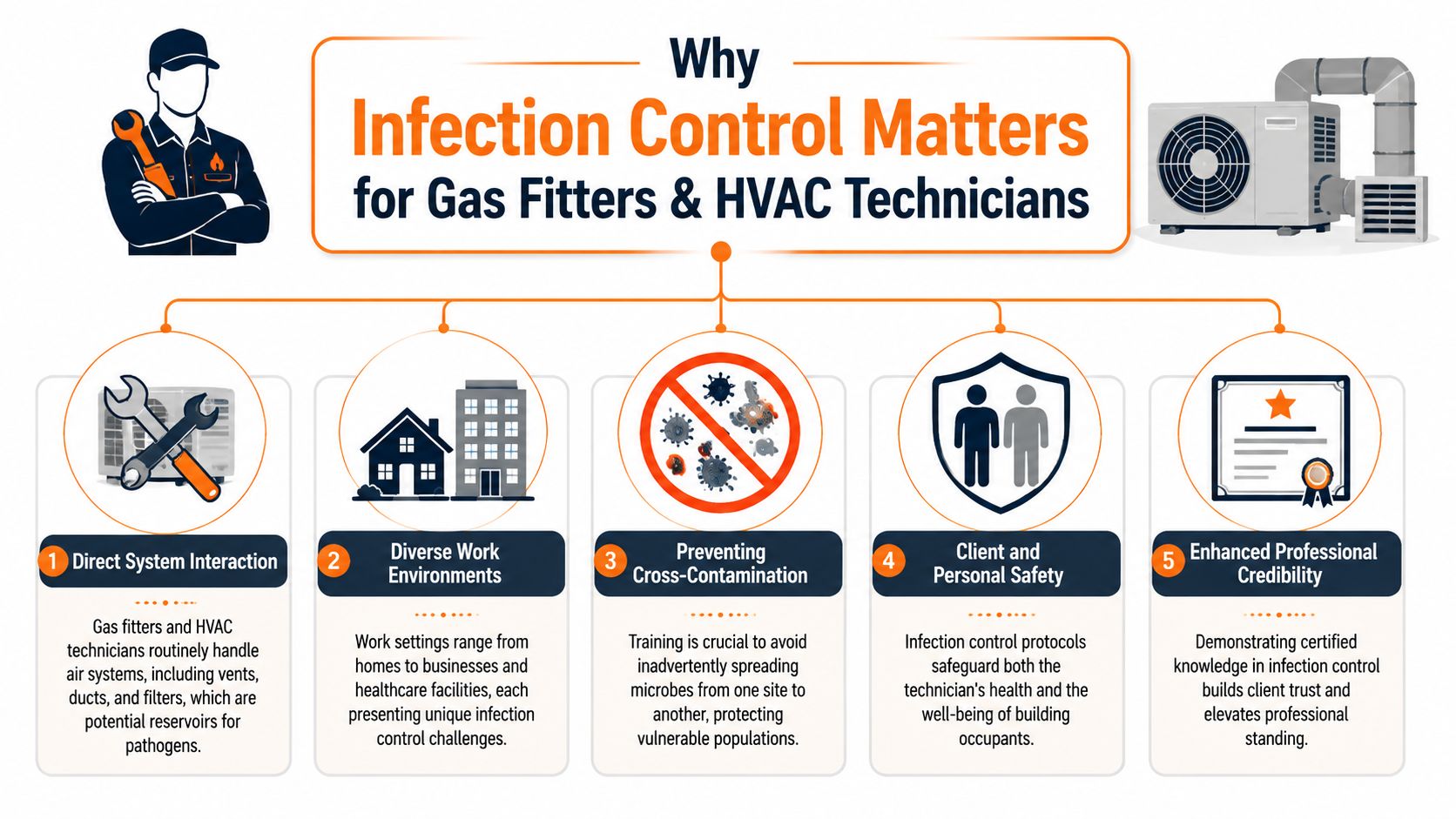
Ontario gas fitters and HVAC techs run into this fast on institutional work. Air systems, pressure relationships, filters, drains, humidification, and service access all affect how a sensitive building operates. In a house or small retail unit, a messy repair is mostly a housekeeping problem. In a hospital, lab, or long-term care home, the same mistake can interfere with isolation measures, contaminate adjacent space, or trigger an incident report.
That matters because our trade works directly on equipment that can spread dust, moisture, and airborne debris if the job is handled poorly. A service call in a boiler room can still affect an occupied wing if the equipment ties into shared ventilation or if your access route crosses controlled areas.
A few field examples make the point:
- **Air-side shutdowns:** Shutting down the wrong unit can change room pressure in nearby spaces, especially where negative or positive pressure needs to stay stable.
- **Dust-generating work:** Cutting access openings, drilling supports, opening old duct, or pulling loaded filters can release debris into areas that need tighter control than a standard commercial job.
- **Tools, boots, and material handling:** Dirt from a rooftop, crawl space, or mechanical room can become a site-access problem once you cross into a healthcare corridor.
- **Water-related equipment:** Drain pans, humidifiers, cooling components, and stagnant sections of piping need disciplined handling because moisture problems can become infection control problems.
For gas and HVAC people in Ontario, that is why this training matters. It translates healthcare rules into job-site behaviour you can use. If you want a practical reference on the trade side of site-readiness, the [Ontario gas and HVAC training resources here](https://flamepath.co/resources) are a better fit than generic healthcare advice.
WHAT EXPERIENCED TECHS DO DIFFERENTLY ON SENSITIVE SITES
The better techs slow down for two minutes before they start. They confirm what the equipment serves, who needs to know about the shutdown, what containment the site expects, and how they will leave the area cleaner than they found it. That habit saves more jobs than speed ever will.
On a sensitive site, good mechanics usually do four things well:
1. **They get the work zone clear before opening equipment.** That can mean checking with the charge nurse, facilities lead, lab contact, or site coordinator before a panel comes off.
2. **They trace the consequences of a shutdown.** A unit may heat one space and pressurize another. If you miss that, you can create a building problem while solving a burner problem.
3. **They control dirt immediately.** Ceiling dust, rust flakes, old insulation, dirty filters, and condensate sludge are handled as contamination risks, not just rubbish.
4. **They follow site PPE and hygiene rules without argument.** On some jobs, gloves and safety glasses are enough. On others, hand hygiene, gowning, clean covers, restricted routes, and waste handling rules are part of access.
That is professionalism clients notice. In institutional work, the contractor who respects infection prevention procedures is usually the contractor who gets called back.
There is also a hard trade-off here. Infection control training will not make anyone better at combustion setup, venting, gas train diagnosis, or code interpretation. It does make a tech safer to send into high-trust environments where a careless entry, dirty tool cart, or uncontrolled opening can shut down access for the rest of the crew. For apprentices trying to move from basic commercial work into hospitals, labs, and long-term care, that difference matters.
FINDING A RECOGNIZED CERTIFICATE COURSE IN ONTARIO
A hospital mechanical room is one thing. Getting permission to enter the corridor outside an isolation area, a lab support space, or an occupied patient wing is another. Ontario gas fitters and HVAC techs need a course that site staff will recognize, because the certificate is often what gets you through the access gate before your tools even come off the cart.

The first point is simple. Do not shop by course title alone.
Ontario techs usually run into four categories: general awareness training, healthcare construction or renovation orientation, broader infection prevention courses, and employer or site-specific modules. Those are not interchangeable. A service tech replacing a gas valve in a long-term care home does not need the same credential as an infection prevention specialist, but the tech does need proof that they understand access rules, contamination control, and conduct inside sensitive spaces.
WHAT THE COURSE SHOULD ACTUALLY TEACH
The right course for a field tech should read like site instruction, not like a clinical textbook. If the outline is built for infection control staff managing policy, it will not do much for an apprentice trying to enter a hospital penthouse, open ceiling space, or move through a controlled corridor without creating a problem for the facility.
Useful course content usually includes:
- **How contamination spreads on a job site:** surface contact, footwear, carts, tools, ceiling dust, and traffic flow
- **Hand hygiene and PPE rules:** what applies before entry, during work, and on exit
- **Containment and barrier basics:** especially for dust-producing work, ceiling access, filter changes, and demolition around occupied areas
- **Clean entry and exit practices:** how to move through a facility without carrying debris into adjacent spaces
- **Permission and communication protocols:** who approves entry, who must be notified before shutdowns, and how work around critical areas is documented
That last point gets missed by younger techs. In healthcare work, being technically right is not enough if you bypass the chain of communication and expose the contractor to a complaint.
Some clients accept a short awareness certificate for anyone stepping on site. Others want a healthcare-construction course for leads, supervisors, or anyone working near patient care areas. Ask the facility, general contractor, or mechanical contractor what they accept before you register and pay.
> **Selection rule:** Match the course to the site's written access requirement.
WHAT "RECOGNIZED" USUALLY MEANS IN ONTARIO
For Ontario gas and HVAC work, "recognized" rarely means one province-wide card that every hospital accepts. It usually means the certificate comes from a provider the client knows, the training topic matches the risk on site, and the proof of completion is clear enough for a coordinator to verify quickly.
That is why a short, practical course can be more useful than a higher-level credential with no relevance to trade access. Some healthcare certifications are aimed at full-time infection prevention professionals and require a very different background. That distinction matters. A gas fitter needs training that supports safe site entry and proper work practices, not a designation built around clinical program management.
ONLINE VS IN-PERSON FOR WORKING TECHS
Course format affects how well the training carries onto the job.
If you already work institutional service and just need a renewal or client file update, online self-paced training is often good enough. If you are new to hospitals, labs, or long-term care work, instructor-led training usually gives better value because you can ask direct questions about tool control, access routes, shutdown communication, and what to do when facility rules conflict with your usual commercial habits.
| Attribute | Online Courses | In-Person Workshops |
| --- | --- | --- |
| **Scheduling** | Easier to fit around service calls and shift work | Better if your employer books a crew block |
| **Learning pace** | You control the speed and can review modules | Fixed pace, but easier to stay focused |
| **Practical discussion** | Often limited to examples on screen | Better for site-specific questions |
| **Best for** | Renewals, experienced techs, quick compliance | First-time learners, leads, hospital-bound crews |
| **Main drawback** | Easy to click through without retaining much | Harder to coordinate and usually less flexible |
There is a real trade-off. Online delivery saves time. In-person instruction usually gives a better field translation, especially for techs who have never worked under healthcare access rules before.
Be careful with out-of-province or U.S. material that mixes local regulations with general infection control concepts. Some of it is useful for background reading, but it may not tell you what an Ontario hospital, lab, or long-term care operator expects from a gas fitter on site. For that reason, client acceptance matters more than marketing language.
If you are comparing providers, ask four direct questions: What sites accept this certificate? How long is it valid? What proof do I receive after completion? Is the course built for contractors entering occupied healthcare or other sensitive environments? For trade licensing study help separate from site-access training, keep the [FlamePath resource library](https://flamepath.co/resources) bookmarked.
HOW TO GET AND MAINTAIN YOUR CERTIFICATION
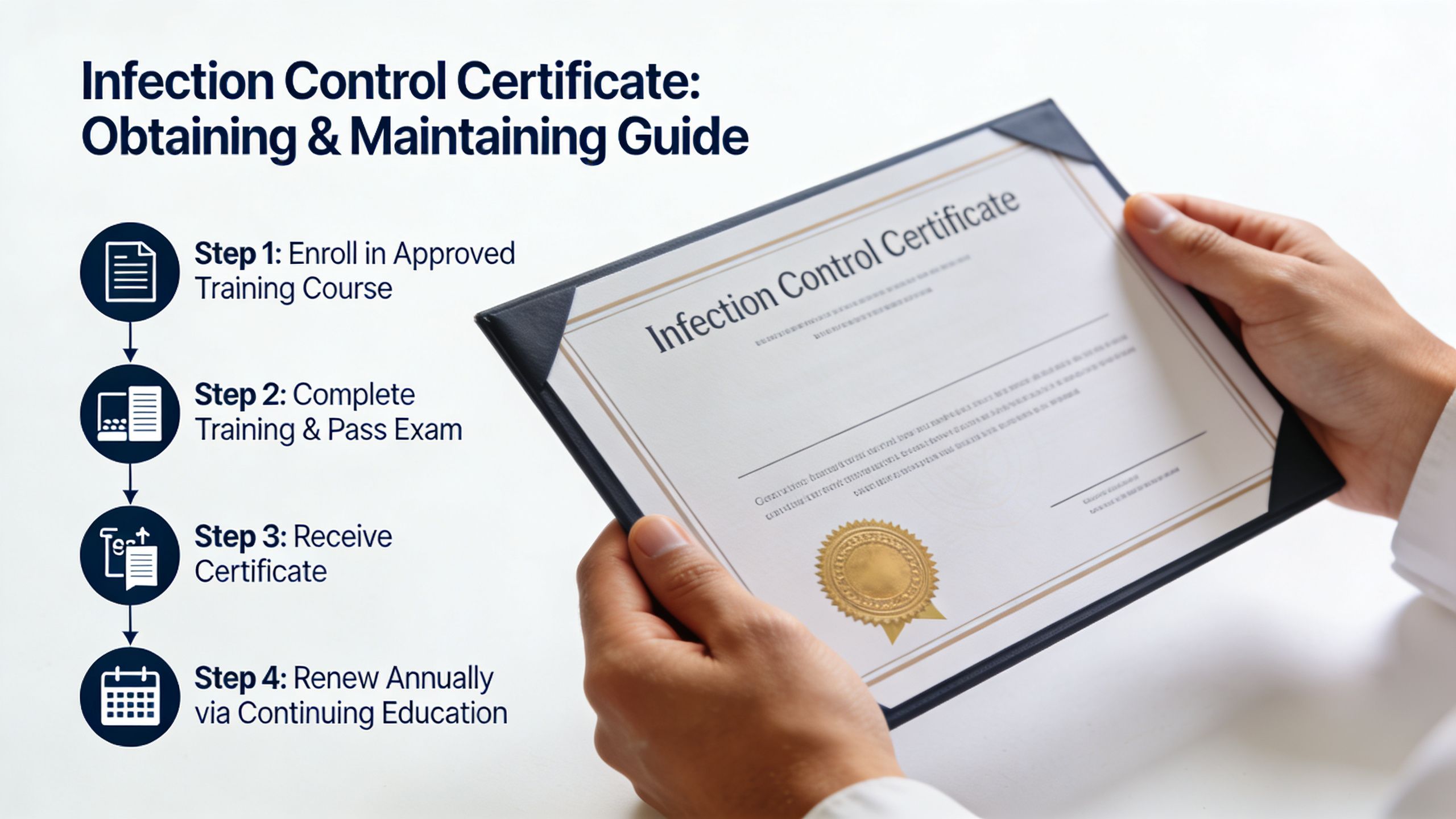
Most Ontario tradespeople make this harder than it needs to be. The process is usually straightforward if you treat it like any other compliance item. Find the right provider, verify the client accepts the certificate, complete the training properly, save the document, and track the expiry before a site asks for it at the last minute.
A SIMPLE PATH THAT WORKS
Use a basic sequence and don't skip the verification step.
1. **Check the client requirement first** Ask the facility, GC, or mechanical contractor what certificate they accept. Some sites will accept general infection control awareness training. Others want a healthcare-construction or site-specific orientation.
2. **Register with a provider that issues clear proof** You want a named certificate, completion date, and a format that's easy to email to a coordinator or upload to a contractor portal.
3. **Take the course as if you'll use it tomorrow** Don't speed-run the modules. Pay attention to access flow, PPE, work-area isolation, and cleaning expectations. Those are the parts that show up in the field.
4. **Pass the assessment and store the record properly** Keep a PDF on your phone, a copy in cloud storage, and a copy with your employer if they manage credentials centrally.
WHAT TO TRACK AFTER YOU PASS
Renewal is where people get burned. They finish the course once, forget about it, then lose access to a good site because the certificate has expired.
A practical tracking system should include:
- **Expiry date:** Put it in your calendar with reminders well before it lapses.
- **Accepted site list:** Note which clients or facilities accepted which certificate.
- **Supporting documents:** Keep fit-test or PPE-related records separate if a site requires them.
- **Supervisor copies:** If you work for a contractor, make sure office staff also have the updated file.
Most site-access certificates for Ontario healthcare and institutional work are treated as annual credentials. The facility, GC, or mechanical contractor will usually state the validity period in their contractor requirements. If it isn't specified, ask directly before you register — some sites accept a two-year renewal cycle, others want proof every twelve months. Many infection-related site-access credentials are not "one and done."
> Keep your proof where you keep your gas licence details, fit-test record, and other site documents. If a coordinator asks at 6:30 a.m., you should be able to send it in under a minute.
Treat it like your code study habits. Small, organised admin beats last-minute scrambling every time.
SHOWCASING YOUR CERTIFICATE ON RESUMES AND JOB SITES
You get called for a hospital boiler shutdown. The scheduler has two techs with similar service backgrounds. One clearly shows infection control training and understands controlled-site conduct. The other buries it at the bottom of a general training list. The first tech usually gets the call.
That is how this credential works for Ontario gas fitters and HVAC techs. It is not about collecting another certificate. It shows a hospital, lab, or long-term care client that you understand how to enter a sensitive space without creating extra risk for patients, staff, research work, or the facility itself.
WHERE TO PUT IT SO EMPLOYERS ACTUALLY NOTICE IT
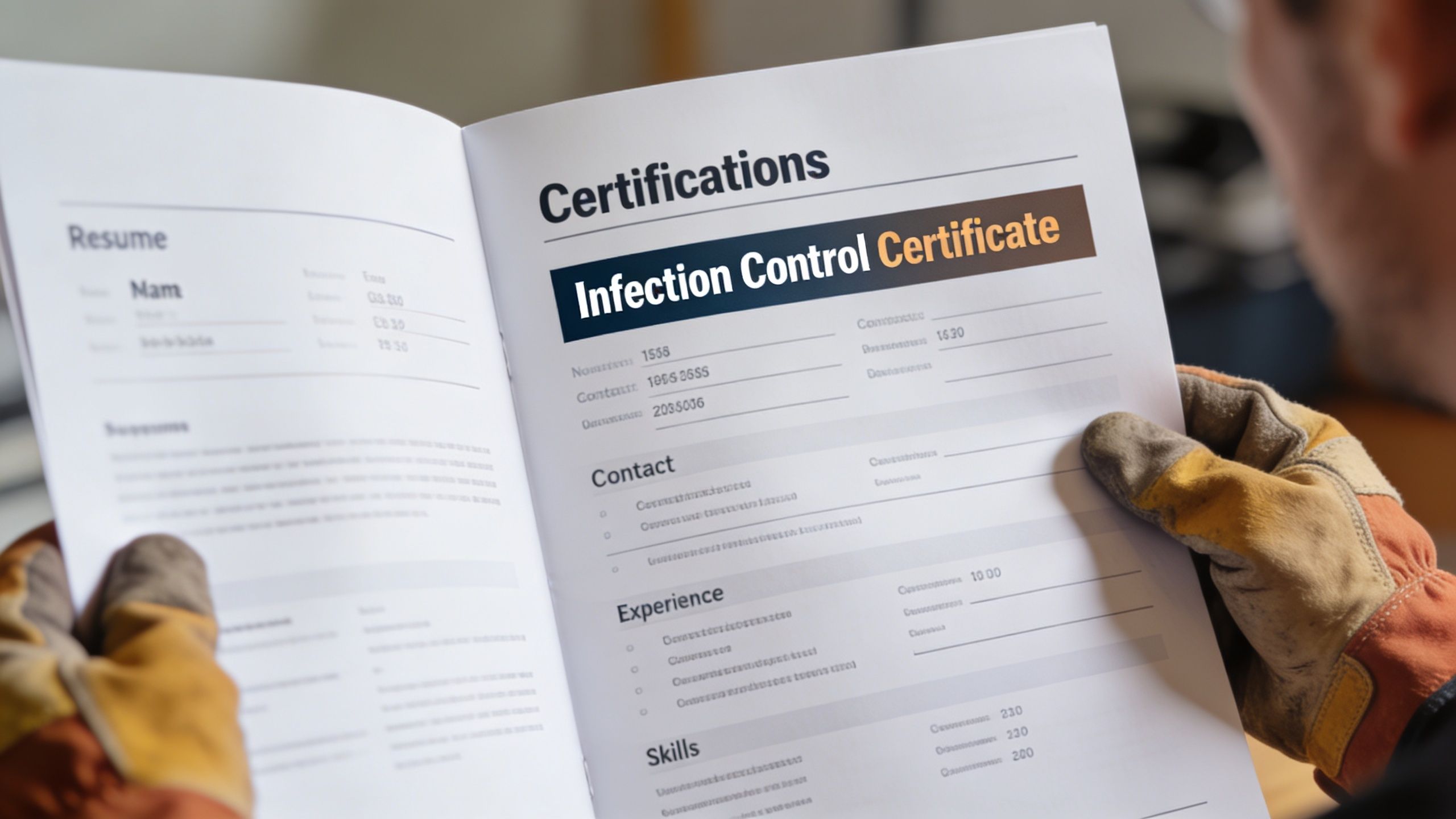
Place it in a **Certifications** or **Professional Development** section in the top third of your resume. If you are applying for institutional service, mechanical maintenance, or project work in healthcare, that placement matters. Hiring managers and service coordinators scan fast.
Use a clean format:
- **Infection Control Certificate** Provider name. Completion date. Expiry date, if applicable.
Apprentices should place it close to their trade status, such as gas schooling, registered apprenticeship details, or progress toward a licence. That pairing sends the right message. You are building trade ability and site-readiness together.
If you are still working toward your licence, pair that with focused prep for the [Ontario TSSA G2 exam course](https://flamepath.co/g2-exam-prep), then show infection control training as the site-access piece that supports better job opportunities.
HOW TO DESCRIBE IT IN EXPERIENCE BULLETS
Do not just list the course and leave it there. Tie it to work habits that matter on controlled sites.
Good examples:
- **Completed service work in occupied and controlled environments while following client infection-control procedures, PPE rules, and access restrictions**
- **Coordinated shutdowns and restart work with site staff to reduce disruption in patient-care or sensitive research areas**
- **Maintained clean work zones, contained tools and materials, and completed closeout to site housekeeping standards**
Those points read better than vague claims about being detail-oriented. They show how you work.
HOW TO TALK ABOUT IT ON THE JOB SITE OR IN AN INTERVIEW
Keep the explanation practical. A site manager does not need a speech. They need confidence that you will respect the room, the people in it, and the process around the work.
A strong answer sounds like this:
> The certificate shows I understand controlled entry, PPE expectations, clean work practices, and coordination with the site before I touch equipment. In a hospital or lab, the repair is only part of the job. How you enter, set up, isolate the area, and leave it matters too.
That is the actual trade-off. A good mechanic can still be a poor fit for healthcare work if he treats every service call like a rooftop unit behind a strip mall. High-value institutional jobs pay for technical skill and disciplined conduct.
If you already have site experience, be specific about the habits the training reinforced:
- **Pre-job communication:** confirm what the equipment serves before shutdown or testing
- **Controlled access:** bring in only the tools and materials needed for that task
- **Housekeeping and closeout:** leave the area clean, contained, and ready for the client's next step
Clients in healthcare and similar environments often work under strict internal procedures, compliance rules, and infection-prevention oversight. That is why they ask for this training from outside trades. For an Ontario gas fitter or HVAC tech, the certificate signals professionalism, site awareness, and lower supervision risk once you are through the door.
YOUR NEXT STEPS TSSA CERTIFICATION AND FAQS
The infection control certificate is a useful add-on for Ontario gas fitters and HVAC techs. It can open doors to cleaner, more controlled, and often more desirable work. But it still sits behind your core trade qualification. If your TSSA licence path isn't solid yet, that's the first problem to fix.
Your real advantage in this trade starts with passing the written exam, understanding **CSA B149.1**, and being able to apply Ontario rules on actual equipment. Site-access credentials help after that. They don't replace it.
For anyone focused on the next licence step, targeted prep for the [Ontario TSSA G2 exam](https://flamepath.co/g2-exam-prep) is where the bigger return usually sits.
QUICK ANSWERS FOR ONTARIO APPRENTICES AND GAS TECHS
**Is an infection control certificate required for a TSSA gas licence?** No. It isn't part of the G3, G2, or G1 licence path.
**Will it help me pass my TSSA exam?** Not directly. TSSA exams focus on gas code, safety, appliances, venting, piping, controls, combustion, and regulation. Infection control training helps with site access and professional readiness.
**Who should bother getting one?** Techs targeting hospitals, long-term care, labs, pharmaceutical facilities, research buildings, and some food-processing environments.
**Is it the same as WHMIS?** No. WHMIS covers hazardous products and labelling. Infection control training deals with contamination risk, controlled environments, PPE behaviour, movement protocols, and work practices in sensitive sites.
**Do I need the advanced CIC credential?** Usually not. That credential is meant for infection prevention professionals in healthcare and has formal experience requirements. Most gas fitters need a site-accepted awareness or construction-related infection control certificate instead.
**What's the biggest mistake techs make?** Treating the course like a paperwork exercise, then showing up on site with the same habits they use in a warehouse or retail unit. Sensitive facilities notice that immediately.
**What's the practical takeaway?** Get licensed first. Add the certificate when the work calls for it. Then use both together to qualify for better jobs and higher-trust environments.
If you're preparing for your Ontario gas licence, [FlamePath](https://flamepath.co) is built specifically for G3, G2, and G1 candidates who need focused TSSA exam prep, realistic mock exams, and code-based practice tied to CSA B149.1 and Ontario Regulation 212/01. It's a practical way to tighten weak areas, study on your phone, and walk into the exam ready.